By Debkumar Bhadra
It is well known that due to ellipticity of Earth’s orbit and the fact that Earth’s axis is not perpendicular to the orbital plane, sunshine hours hence length of a day and for that matter the night varies from place to place and also from one season to another. The difference widens as one moves from equator towards the poles, whereas for places in the tropical region, the differences vary slightly.
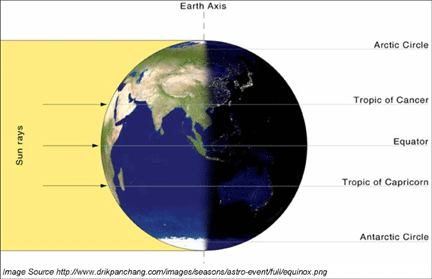
However during two occasions (in a year), the axial tilt does not seem to affect the sunlight incident on Earth. One such occasion falls on 22 September 2012, when the geometric center of the Sun’s disk would apparently cross the celestial equator from North to South, and this point would remain above the horizon for 12 hours everywhere on Earth. Around this time, Sun’s rays would fall more and more vertically, thus length of the day and night would be equal called Equinox.
The word EQUINOX is derived from the Latin aeques (equal) and nox (night), meaning equal night. During this time of the year, the sun is at one of the two opposite points on the celestial sphere where the celestial equator and the ecliptic intersect. Equinox occurs on two occasions in a year around September 22/23 called the Autumnal (Fall) Equinox and during March 20/21 called the Spring (Vernal) Equinox.
Apart from equal nights, other effect of equinoctial periods includes temporary disruption of communications satellites. Near the equinox, the Sun goes directly behind the (geostationary) satellite relative to Earth (i.e. within the beamwidth of the ground station antenna). Hence for a short period, the Sun’s immense power and broad radiation spectrum overload Earth station’s reception circuits with noise. Depending on antenna size and other factors, the event may temporarily disrupt or degrade the circuit.
For a common man, Autumnal Equinox marks the fall of 2012 in the northern hemisphere (for Southern hemisphere it is Vernal Equinox) sounding departure of Summer and arrival of Autumn (Winter). This day is officially the first day of Autumn; one of the four temperate seasons. Starting this date, temperature in the northern hemisphere begins to drop and day gets shorter than nights. Trees bear the last bloom before winter sets in and leaves change colour. One can observe changes in animal behavior and plant growth.
There are several other interesting signs as well. Just look around for the faintest clue, listen to the increased chirp of birds and share your feelings.


