
By Staff Reporter
Every NGO begins with an idea—a desire to address a social need, support a community, improve access to education or healthcare, protect the environment, or respond to a problem that demands collective action. But turning that idea into a functioning and sustainable institution involves a journey that extends well beyond good intentions.
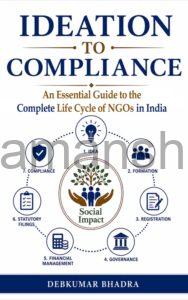
A new handbook by Andaman-based author Debkumar Bhadra seeks to bring that entire journey together in one volume. Titled Ideation to Compliance: An Essential Guide to the Complete Life Cycle of NGOs in India, the book examines the legal, administrative, governance, financial and compliance aspects involved in establishing and running a voluntary organisation.
In a recent chat with the author revealed the idea for the book grew out of his own experience of establishing SPARSHA (Society for Promotion of Serve Humanity Among Youths). The process offered a practical lesson in the complexities that can confront those seeking to establish a voluntary organisation.
Information relating to NGOs is widely available, but it is often spread across different laws, rules, government notifications, portals and procedural requirements. For a first-time founder, locating information is therefore only one part of the challenge. Understanding what applies at each stage, and how one requirement connects with another, can be equally difficult. Ideation to Compliance: An Essential Guide to the Complete Life Cycle of NGO’s in India is an extension of that learning experience.
The COVID-19 pandemic also highlighted the important role played by voluntary organisations. At a time when communities faced unprecedented disruption, NGOs frequently worked as facilitators, helping bridge gaps between institutions and people and reaching sections of society that required assistance. The experience reinforced the importance of organisations that are capable not only of responding to social needs, but also of sustaining their work through sound institutional systems.
The central thesis of Ideation to Compliance is that an NGO’s institutional journey does not end when it receives a registration certificate. Registration under a legal framework is only the beginning.
The handbook follows the organizational life cycle of an NGO right from the initial idea and choice of legal structure through formation and registration, subsequent statutory registrations and requirements, governance and management, financial systems to compliance. It also brings together practical model documents and templates intended to help readers translate requirements into organisational practice.
The book covers the principal legal forms through which charitable and voluntary activity can be organised, including societies, public charitable trusts and Section 8 companies. It then moves into the requirements that arise after formation, including tax-related registrations and benefits, banking and other statutory formalities, CSR-related requirements and, where applicable, FCRA compliance.
The later stages of the institutional journey receive equal attention, with governance, accounting, financial management, record-keeping and annual statutory compliance forming part of the larger picture. In this sense, the book treats registration not as the destination, but as one milestone in the life of an NGO.
For many organisations, compliance can initially appear to be a technical exercise involving forms, records and deadlines. But the handbook places these requirements in the broader context of institutional credibility.
An organisation entrusted with donations, grants or community responsibilities needs systems that allow its decisions and finances to be properly recorded and accounted for. Governing bodies need defined procedures. Financial transactions need appropriate documentation. Statutory obligations need to be tracked and met.
Such systems are not separate from an NGO’s social purpose. They provide the institutional foundation that allows that purpose to be pursued consistently and responsibly.
This becomes increasingly relevant as voluntary organisations interact with donors, philanthropic institutions, CSR programmes and government agencies. Smaller and newly formed NGOs may have strong social motivation but limited familiarity with the administrative and regulatory framework within which they operate.
The challenge, therefore, is not simply to encourage more people to establish NGOs, but also to help them build organisations capable of surviving, earning trust and remaining accountable.
Ideation to Compliance is intended for a broad readership, including NGO founders, trustees, governing-body members, social entrepreneurs, CSR professionals, accountants, researchers and students.
Its practical orientation is reflected in the inclusion of model documents, resolutions, registers, templates and checklists alongside explanations of the legal and institutional framework. The intention is to make the various stages of an NGO’s journey easier to understand and navigate, particularly for those encountering these requirements for the first time.
The publication also represents an unusual journey in itself—from an experience of building a voluntary organisation in the Andaman and Nicobar Islands to a handbook addressing the institutional life cycle of NGOs across India.
With the eBook already available and print editions expected in early October, Ideation to Compliance: An Essential Guide to the Complete Life Cycle of NGO’s in India authored by Debkumar Bhadra brings together a journey that is often encountered in fragments.


