
AKRITI SORENG
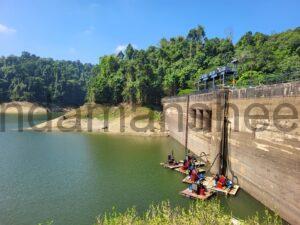
Sri Vijaya Puram is facing increasing water stress as Dhanikhari Dam remains at around 56 meters, significantly below its full capacity. Tourist arrivals across the Andaman and Nicobar Islands recorded a total of 357,453, marking an increase of 15.60% in 2023-24. The 2011 Census recorded South Andaman’s population at approximately 238,145, which now effectively rises to around 3-4 lakh with the seasonal influx of tourists, nearly doubling the growth, with a further increase of up to 25% projected for 2025, straining the Dhanikhari Dam’s water resources.
Despite the completion of the Rutland Stage-I project in 2021, delivering around 6.60 MLD from five marked perennial sources through a submarine pipeline project to Pongi Balu and Dhanikhari Dam, easing the shortage, PBMC sources call the Rutland Stage-II project a “Big Failure”. The project has been delayed and remains stalled, leaving the dam standing at 56 meters.
The Flat Bay freshwater lake and water supply project, an initiative of the Andaman and Nicobar Administration being handled by APWD, is under active consideration to construct an embankment for a freshwater source along with a smart city desalination plant to offer fast relief for citizens. The Flat Bay project is expected to provide 65 MLD of water, while the current Dhanikhari level remains at 56m. However, the latest update shows actual implementation is pending and completion will depend on approvals, funding, and execution progress over the coming years.
| Factors | Current Reality | Needs |
| Population strain | 238,142 locals + seasonal tourist influx | A single dam cannot sustain the growing demand in South Andaman |
| Monsoon failure | Deficit in seasonal rainfall | Multi-reservoir systems and mechanisms to harvest rainwater |
| Infrastructure loss | Leaky pipes and runoff losses | Weirs and additional water storage structures to capture runoff |
South Andaman urgently needs another dam due to chronic rainfall shortages amid surging demand and limited functional capacity. Dhanikhari, despite its increased height, depletes rapidly. For the Andaman and Nicobar Islands, the monsoon is not just weather; it is a test of whether islanders can secure enough water for another season. South Andaman is the region facing the highest water stress because it carries the largest population, handles the greatest urban load, and faces increasing tourism pressure. Southwest monsoon (May-September) and northeast monsoon (October-December) together average around 3,000 mm to 3,500 mm annually.
Recent rainfall across the Andaman and Nicobar Islands has remained sharply below normal during March-April 2026. Data suggested by IMD shows South Andaman recorded 31.5 mm against the normal 120.5 mm, a deficit of over -74%. Nicobar recorded 38.1 mm against a normal of 198.1 mm, showing a departure of -81%, which was slightly less severe than South Andaman. Middle and North Andaman recorded only 2.2 mm of rainfall against the normal 69.2 mm, the worst deficit in the region, with almost no rainfall against the expected level.
In a region where water supply depends heavily on seasonal rainfall, this deficit creates a major challenge and leaves very little margin for recovery. Weak rainfall means less recharge of reservoirs, the Dhanikhari Dam receives lower inflows, and water rationing becomes harder to ease.
SVPMC launched the “Stop the Leakage, Save Water Campaign” on 26th February 2026. The Administration has turned to leak reduction as an immediate way to conserve water and reports that 33,500 litres of water have been saved through the identification and rectification of leakages. Inspection of pipelines, repair of old pipes, and active monitoring to control overflow are also underway.
South Andaman requires stronger long-term planning because it faces multiple pressures that need urgent attention, including rising population growth, unreliable rainfall, and limited storage options. The future sustainability of the islands depends on whether they can support continued population expansion.
Dhanikhari Dam remains the main water supply source. Recent seasonal data shows large rainfall deficits across the region, which means the islands are not receiving sufficient recharge when it is needed most. Population growth plus tourism influx no longer guarantees water security. Recent measures may provide temporary relief but are not a permanent solution.
Sri Vijaya Puram’s yearly water crisis can end with practical long-term measures if implemented effectively. South Andaman has been experiencing this crisis for more than a decade, and every summer the crisis returns stronger, creating a deeper gap than the previous year. Rainfall recorded in 2026 was just 10 mm in January, 15 mm in February, and 10 mm in March, the lowest level recorded in five years. The ratio is simply unforgiving; a single ageing reservoir cannot serve a population that effectively doubles when tourist numbers are included. Likewise, a single monsoon-dependent catchment cannot provide long-term resilience.
A radical new design, such as a second dam strategically located to harvest runoff independent of the Dhanikhari catchment, would provide the resilience that repair works alone cannot achieve. This is the basic redundancy principle that a water-stressed city needs to operate on.
Even BJP’s formal submission to the Union Home Minister in January 2026 calling for an additional dam near Dhanikhari, desilting of the existing reservoir, and enhanced rainwater storage systems signals a tactical acknowledgement that the current single-source system has reached its limit.
The Rutland pipeline project, the Flat Bay project, and SVPMC’s Save Water Campaign are valuable supplements, but they cannot solve a system already operating under deficit conditions. The islands cannot rely solely on a limited water management strategy. South Andaman needs major improvements to its existing infrastructure and a long-term alternative solution. A second dam remains one of the most practical options to reduce the acute water scarcity faced by islanders every year.


