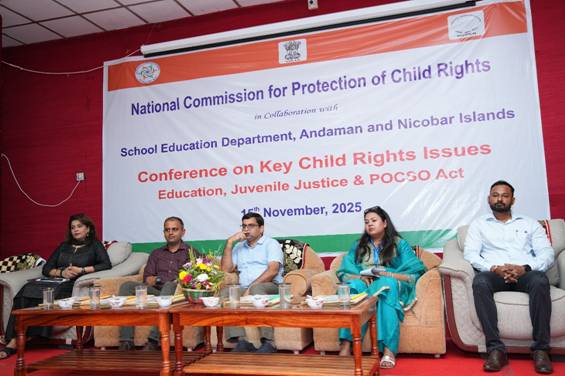
Sri Vijaya Puram, Nov 16: The National Commission for Protection of Child Rights (NCPCR), in collaboration with the School Education Department, Andaman & Nicobar Island successfully organised a One-Day State Level Program on Child Rights issues with focus on Education, Juvenile Justice, POCSO Act at the Auditorium Tagore Government College of Education dated 15 November 2025.
The one-day deliberation brought together District Administration, District Education Officers, members of School Management Committees (SMCs), Parent-Teacher Associations (PTAs), Child Welfare Committees (CWCs), District Child Protection Officers, Special Juvenile Police Unit, and Child Protection Police Officer etc to discuss upon the to identify actionable solutions under key child protection frameworks including the Right to Education Act (RTE) Act 2009, Juvenile Justice (Care and Protection of Children) Act, 2015, and the Protection of Children from Sexual Offences (POCSO) Act, 2012.
The conference commenced with lighting of the ceremonial lamp and felicitation of dignitaries.
While delivering the keynote address, Ms. Mahima Lal NCPCR, said that child right cases are not mere statistics. Each of them is story of a child and a family. The lives our citizen and future of our country depend on the actions taken by Government officials. She said that the Central, State Government and UT Administration is committed to protect the rights of every child, the onus is on all the stakeholders to realize the objectives of the Government. Ms. Lal stressed on the need of creating awareness among the officials through training, among the citizens through various media vehicles, and among other key functionaries by arranging conferences and workshops. Ms. Lal informed the audience that during last 6 months, NCPCR has disposed around 26,000 cases, rescued over 2300 children, repatriated over 1000 children to their home district CCIs, and inducted latest technology for management of NCPCR. She apprised the participants about the future endeavours of NCPCR, which include addressing the mental health issues of the children, development of AI tool for addressing the menace of Child Sexual Abuse Material (CSAM), and developing the new strategies to address the challenges arising out of implementation of key child rights legislation. She also said that inspired by the praise of sugar board by the Prime Minister, the Sugar Board initiative of NCPCR has been adopted by large number of schools.
Mr. Vikram Singh Director, School Education Department, who emphasized the pivotal significance of the workshop, describing it as a vital step in advancing girls’ empowerment both within the school system and across society. He affirmed that education is the most transformative force, enabling girls to acquire the knowledge, skills, and confidence needed to break traditional gender stereotypes and realize their full potential. The workshop, he noted, was not merely an informational exercise but a purposeful initiative to instill a sense of agency in children specially girl child, equipping them to make informed choices about their lives, careers, and contributions to the community. He further drew attention to the critical frameworks of Juvenile Justice and the POCSO Act, stressing their role in protecting children from exploitation and ensuring swift, compassionate redressal of grievances. The Director (Education) urged stakeholders to strengthen awareness, enforcement, and sensitivity in dealing with child rights issues, noting that true progress lies in harmonizing education with justice and protection. His remarks served as a reminder that safeguarding children’s dignit and well-being is both a moral imperative and a national priority.
Mr. Uma Shankar, (DANIPS) Superintendent of Police training school also attended the said program.
The technical deliberations covered three major thematic areas:
1. Accountability Framework: Responsibility of School, School Management, and Head of School: Roles of different stakeholders in ensuring the safety and security of children in schools presented by Ms. Rubina Khatib Siddiqui (Former A & N UTCPCR and Eminent Educationist) focusing
2. Safe and Secure School Environment – empowering teachers, parents and school management committee members etc by Ms. Mahima Lal, NCPCR.
3. Issues and gaps in implementation of Juvenile Justice Act, 2015 and POCSO Act, 2012 by Ms. Jyoti Chhatwal (SHO, Anti trafficking Unit)
Each session underscored the urgent need for institutional strengthening, training of functionaries, and improved inter-departmental convergence to translate legislative intent into on-ground protection.
Drawing upon the deliberations and NCPCR’s thematic presentations, the following key issues to be addressed and recommendations emerged:
• Juvenile Justice (Care and Protection of Children) Act, 2015
• Inadequate staffing and infrastructure for CWCs, JJBs, and DCPUs.
• Need for improved inspection and monitoring of Child Care Institutions.
• Strengthening aftercare, adoption, and rehabilitation linkages.
• Integration of Track-Child and CCTNS for real-time case monitoring.
• POCSO Act, 2012
• Under-reporting due to social stigma and limited community awareness.
• Delays in investigation, medical examination, and trials.
• Shortage of Special Courts and child-friendly infrastructure.
• Requirement of trauma-informed counselling and witness protection mechanisms.
• Safety and Security in Schools
• Need for full compliance with NCPCR’s Manual for Safety and Security of Children in Schools, including safety audits, CCTV monitoring, and background verification of staff.
• Emphasis on cyber-safety, prevention of bullying, and mental-health support for students.
• Capacity building of school management committees and orientation for teachers.
• Child Trafficking and Convergence
• Strengthen coordination among Police, Labour, and Social Welfare Departments.
• Establish district-level child trafficking task forces with cross-border collaboration.
• Conduct awareness campaigns targeting high-risk communities and transit points.
About NCPCR
Established in 2007 under the Commission for Protection of Child Rights Act, 2005, NCPCR is India’s apex body mandated to monitor and promote the protection of child rights across all sectors. Guided by its motto “BhavishyoRakshatiRakshitah” (“The Future Protects Those Who Protect It”), the Commission continues to lead national efforts to ensure every child’s right to survival, development, protection, and participation.
Issued by:
National Commission for Protection of Child Rights (NCPCR) Under the Ministry of Women and Child Development, Government of India in collaboration with: School Education Department.


