
Rahul Singh
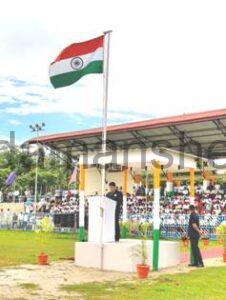
Campbell Bay, Aug. 16: Mr. Shivam Tashi Dhawa, DANICS, Assistant Commissioner, Campbell Bay, on the occasion of the 80th Independence Day, extended his greetings to the people of Great Nicobar and paid tribute to the freedom fighters whose sacrifices laid the foundation of an independent India. Addressing the Independence Day programme at Campbell Bay on August 15, he said that the national day was not merely an occasion to celebrate freedom but also an opportunity to remember the courage, sacrifice and dedication of those who devoted their lives to the country’s independence.
In his address, the Assistant Commissioner said that August 15, 1947, marked a historic and golden moment when India began its journey as an independent nation. He highlighted India’s progress in science, space, education and sports, while emphasizing that the country’s real strength lies in unity, brotherhood and collective commitment. He also called upon the people to work together towards building a developed, clean, safe and self-reliant Great Nicobar.
Giving an overview of the major developmental activities and achievements of various departments in Campbell Bay Sub-Division, Mr. Dhawa highlighted the important role played by government officials, employees, public representatives and local residents in the development of the region.
Under the Campbell Bay Sub-Division (AC Office), a State-level Tsunami and Cyclone Disaster Management Mock Exercise was successfully conducted on March 16, 2026, with the participation and coordination of various departments. The exercise demonstrated the preparedness and rapid response capabilities of the administration and concerned agencies in dealing with disasters. International Yoga Day was also observed at several locations, including Indira Point, the southernmost point of India, Laxman Beach, Maccachuwa and Afra Bay, with participation from government departments, defence forces, local institutions and villagers. The training and survey work for Phase-I of Census 2027 was also successfully completed.
Highlighting the achievements of the Community Development Block, the Assistant Commissioner said that 11 individual household toilets were sanctioned for tribal beneficiaries under the Swachh Bharat Mission-Gramin. Under the Pradhan Mantri Awas Yojana-Gramin, the second instalment was released to two beneficiaries, while five houses were completed. Land surveys and review of Permanent Waiting List cases for eligible landless beneficiaries were also initiated. Ten training programmes were conducted under the Rashtriya Gram Swaraj Abhiyan, while 15 mobilisation camps under the Deen Dayal Upadhyaya Grameen Kaushalya Yojana were organised, benefiting 35 candidates.
Under the Deendayal Antyodaya Yojana-National Rural Livelihood Mission, one Self Help Group and one Village Organisation were formed. Five SHGs received ₹6.30 lakh in Community Investment Fund support, while 100 Lakhpati Didis were registered and a Tribal Haat Mela was organised. Under the Viksit Bharat Rozgar Evam Aajivika Mission-Gramin, four works were taken up, of which two have been completed and two are in progress. A total of 73 families were provided employment, generating 1,737 person-days, including 1,303 person-days for women, while 14 new job cards were also issued.
The Andaman Public Works Department (APWD) made significant contributions to strengthening public infrastructure in Great Nicobar. The department completed construction of additional classrooms and toilets in school buildings, the Civil Air Terminal at INS Baaz and improvement and widening works on various stretches of the North-South Road. Construction and repair works relating to research stations, the Primary Health Centre, rural roads, ponds and community buildings were also undertaken. Survey, demarcation and installation of boundary pillars in forest and project areas were carried out, contributing to the development of tribal areas and strengthening public infrastructure.
The Education Department undertook several initiatives aimed at the overall development of students. The successful organisation of the Education Premier League, establishment of a Science and Mathematics Park and participation of students in national-level competitions were among the major achievements highlighted in the address. Various activities were organised to encourage scientific thinking, sportsmanship, leadership qualities and innovation among students. The department also continued efforts to promote quality and inclusive education while ensuring that students remain connected with moral values and discipline.
On the health front, the Primary Health Centre strengthened healthcare services and worked to extend facilities to remote areas. Primary healthcare, maternal and child health, immunisation, prevention of communicable and non-communicable diseases and various public health programmes were effectively implemented. Training programmes were conducted for health workers and the community, while ABHA IDs were generated under the Ayushman Bharat Digital Mission. Maternal and child healthcare, institutional deliveries, family planning and universal immunisation services were strengthened. Awareness and control programmes relating to tuberculosis, AYUSH, HIV/AIDS, malaria and dengue were also conducted. Under the Pulse Polio campaign, 251 children were vaccinated.
The Agriculture Department focused on increasing farmers’ income, promoting modern agricultural practices and supporting sustainable agricultural development. Various agricultural inputs, improved seeds, fertilisers and bio-pesticides were distributed at subsidised rates. Horticulture, agricultural mechanisation and modern agricultural equipment were promoted under MIDH and the National Agriculture Development Scheme. A total of 165 soil samples were tested and scientific advice was provided to farmers, while 300 farmers benefited from the PM-KISAN Samman Nidhi scheme. High-value spice crops were promoted under the Spices Development Programme. A copra drying and packaging unit was established, 881 agricultural plots were digitally surveyed, and training, demonstrations and farmer awareness programmes were conducted through UTATMA.
The Fisheries Department conducted 10 awareness programmes during the year to disseminate information about government schemes. Subsidies were provided to beneficiaries under the Pradhan Mantri Matsya Sampada Yojana, while applications were received for new assets. A total of 150 fishing licences were renewed and two Panchayats and two FNC areas were brought under various schemes. Under the Group Accident Insurance Scheme, 253 fishermen and fish vendors were provided insurance coverage.
The Animal Husbandry and Veterinary Department carried out various activities for livestock development, animal health and strengthening rural livelihoods. Artificial insemination, animal birth control, treatment, vaccination and animal health camps were organised. Livestock owners were provided training, while ear-tagging and digital registration of animals were also undertaken. Egg production at the Integrated Livestock Farm was increased, and beneficiaries received subsidised animals and poultry birds under different schemes for dairy, poultry, goat, pig and duck farming. Poultry vaccination and livestock development programmes further supported rural livelihoods.
The Electricity Department also undertook important measures to strengthen power supply in Campbell Bay. A 320 KVA DG set was installed and commissioned at Campbell Bay Power House to ensure electricity supply to the Coast Guard feeder during peak hours and minimise short-duration interruptions. A 62.5 KVA DG set was also installed and commissioned at the Maccachuwa Community Power House. The department has been making efforts to maintain 24×7 power supply in Campbell Bay while minimising power interruptions in the public interest.
The STS Transport Unit, Campbell Bay, took several measures to improve public transportation, road safety and passenger convenience. Free motor driving training was initiated for the tribal community of Great Nicobar. Special bus services were provided for passengers arriving on delayed ships, and bus schedules were modified according to public requirements. Regular driving tests and vehicle fitness tests were conducted to improve road safety. A new mini bus terminus was constructed and inaugurated at Campbell Bay, providing improved facilities to passengers. Unserviceable buses and spare parts were disposed of as per regulations for better resource management.
The Police Department, Campbell Bay, continued its efforts towards maintaining law and order, controlling crime and ensuring public safety. A total of 436 traffic challans were issued and more than ₹2.61 lakh in fines was collected. Action was also taken against drunk driving. Special drives against illicit liquor resulted in the registration of 15 excise cases, with substantial quantities of illegal liquor and lahan seized and destroyed. Community policing initiatives included meetings with public representatives and local residents. A total of 34 awareness programmes were organised on POCSO, cybercrime, road safety, drug de-addiction and legal awareness. The police also solved a serious crime through prompt and scientific investigation, arresting the accused within two hours, demonstrating the efficiency and commitment of the department.
The AAJVS Tribal Welfare Department continued its efforts towards the health, education and overall development of tribal communities in Campbell Bay. Under the PM-JANMAN scheme, medical camps, health check-ups, distribution of medicines and essential materials and regular medical outreach programmes were organised. Tribal students were provided educational assistance, scholarships and guidance, while the needs of tribal communities relating to health, education and livelihood were continuously assessed. Welfare schemes were extended to tribal families and coordination with various departments was undertaken for effective implementation of development works and awareness programmes.
Concluding his address, Mr. Shivam Tashi Dhawa said that the achievements of Great Nicobar were the result of the collective efforts and dedication of the administration, government departments, officials, employees, elected representatives and local residents. He urged everyone to work together towards creating a developed, clean, safe and self-reliant Great Nicobar, describing it as the true tribute to the freedom fighters of the country.
He extended his Independence Day greetings once again and concluded with a message urging people to rise, remain alert and move forward with hard work, unity and determination. He said that the tricolour in every heart and India in every breath should remain the collective identity and resolve of the people.


