
Vanshika Sarkar
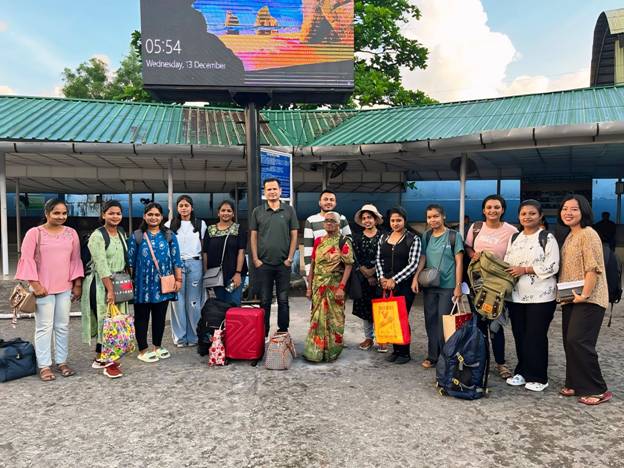
Recently, my friends and I embarked on a three-day educational tour to Neil Island (now Shaheed Dweep), a tiny and beautiful island approximately 40 kilometers from Port Blair. The tour was a part of our M.Sc. course curriculum and was organized by the Department of Botany, Jawaharlal Nehru Rajkeeya Mahavidyalaya, Port Blair. Our esteemed Head of Department (HOD) supervised and meticulously planned the tour, ensuring a smooth experience for everyone. The study tour comprised students from the final year of M.Sc. Botany, including Neela Aunty (department lady staff) and our HOD sir. Our primary objective was to collect information about the biogeography of Neil Island and study its floral diversity.
One fine morning, we reached the Phoenix Bay Jetty for our ship journey to Neil Island. Our tickets were pre-booked so everything was hassle-free. At around 6.30 am, we boarded the government passenger ship, MV Kamorta. The journey was breathtaking. As we left the jetty, I got the opportunity to view my beautiful island from the sea. We all had a great time on the ship, taking selfies and pictures of nature. We saw flying fish and marveled at how these tiny ray-finned fish have evolved this gliding ability to escape predators. We also had light refreshments while enjoying the beautiful view of the faraway islands. We arrived at Neil by 8:30 am and headed straight to our pre-booked resort, Neil Banjara, taking shared autos.
We checked in at the resort and were happy to learn that the manager of Neil Banjara Resort is an alumnus of our college. We were hungry and enjoyed a delicious breakfast of puri-sabzi and tea. Afterward, we were assigned rooms with three members in each. Our rooms were quite nice, and after freshening up, we gathered at the reception. There, Sir instructed us about the places we would visit and the schedule for each location. We left the resort around 11 am and visited Lakshmanpur Beach, where we explored the area and learned about various local plant species.
We took pictures of the beautiful coastline and different plant species. We learned many new things. Our HOD explained the types of forests found on Neil Island, highlighting their characteristic features. Neil Island boasts a tropical forest habitat where climbers and creepers grow luxuriantly. Here, the soil is comparatively less fertile than in temperate regions. This is because the place witnesses a lot of rainfall and sunlight, resulting in mineral leaching. This makes the soil poorer in humus content. Also, sir told us about the importance of the wood-wide-web (www), an intricate underground network of fungi that connects the roots of trees and other plants in a forest ecosystem and facilitates nutrient exchange.
On our way to Lakshmanpur Beach, the showy flower of Andaman Planchonia (Planchonia andamanica), a plant native to these islands, stole our attention. The wild petunia (Ruellia simplex) was blooming and everyone admired its trumpet-shaped flowers. On our way, we also saw sea hibiscus or beach hibiscus (Hibiscus tiliaceus), prominently displaying its yellowish-orange flowers and heart-shaped leaves. This plant can tolerate salty conditions and thrive in sandy soils. Naturally, it becomes a good choice for coastal gardens. We were intrigued to know how beach morning glory (Ipomoea pes-caprae), with its extensive root system, can prevent erosion and play a crucial role in stabilizing coastal areas.
After exploring the rich flora, we returned to the resort for lunch. We rested for a while and headed towards Laxmanpur Beach for the sunset view. I was amazed to see the beautiful view of the sunset. Even though the beach was crowded, we captured every moment of the sunset. The weather was pleasant and we enjoyed walking along the shore collecting seashells.
After the sun set below the horizon, we returned to the resort and had dinner around 8:30 pm. The internet connectivity is poor on Neil Island. Thankfully, the resort provided us with wifi. We all sat in the common area and shared and posted pictures of the beautiful day on social media. We also played some games before going to our respective rooms for some much-needed sleep.
The next day, I woke up early and enjoyed the sunrise from our room’s corridor. We gathered for breakfast at 7:30 am. After a delicious breakfast, we went to Bharatpur Beach. The beach is famous for water activities. We went for glass-bottom boating, which was an exciting and enjoyable experience. We saw different types of corals, such as finger corals, table-top corals, mountain corals and mushroom corals. The colourful fish swimming beneath our boat was a great sight to watch!
After the exciting boating experience, we found a serene and peaceful spot on the beach. We relaxed there, enjoying some snacks and juices. The amazing sea view mesmerized me. At around noon, during low tide, we went to see the famous Natural Bridge at Lakshmanpur Beach. The Natural Bridge, a living coral formation, is nicknamed ‘Howrah Bridge’ by the locals. It attracts many visitors from different parts of the country and abroad. We took many pictures of the bridge, amazed by the sight of starfish swaying along the waves. Pure bliss!
An interesting story unfolded while we were at Lakshmanpur Beach. One of my friends spotted a phone at the beach. We somehow tracked down the rightful owner and returned the phone. He was vacationing in Andaman with his family and was very happy after reuniting with his lost smartphone. He thanked us very much and offered us refreshing sweet lemon juice as a token of immense gratitude. We couldn’t refuse the delicious reward for our honesty.
By 2 pm, we had returned to the resort and had lunch. We were very tired from the full-day activities. We rested for a while, and in the evening, we discussed the possibility of exploring a farm the next day, self-cooking, and witnessing the diversity of plants in its vicinity. Luckily, one of my friend’s uncle, a kind-hearted soul, helped us enormously in finalizing our plan. He consented to provide his farm for plant exploration. We found different species of Colocasia and bought a few for our home. Sometimes, due to erratic cargo arrivals, potatoes become a rare treat on the A & N islands. So, we were naturally drawn to the air potatoes (Dioscorea bulbifera), and many of us collected them. We also collected the saplings of one of the hottest chillies, called Bombay Mirchi. It was great fun exploring and cooking on our own. We enjoyed watching nature, the pond, ducks effortlessly gliding on water, and the vibrant dance of the dragonflies and colourful butterflies. Thereafter, all of us had a very yummy meal. A local sweet dish, Neil’s Rasgulla was part of the feast. As the saying goes, ‘If you don’t eat rasgulla while in Neil Island, you have missed out on something.’ Honestly speaking, I learned an important chapter of my life – the importance of working together and collaborating to accomplish our shared goals.
Finally, it was time to wrap up our wonderful journey. We arrived at the Neil Island jetty around 3:30 pm. Our ship, MV Ranichanga, was delayed by 30 minutes. So we took the opportunity to buy some snacks – chips, tangy tamarind candy and rasgullas. After boarding the ship, my friends and I headed to the top deck to enjoy the beautiful sunset. The journey back to Port Blair took about two hours. We reached home safely by 7 pm.
Our educational tour of Neil Island was an enriching and enjoyable experience. I learned a lot about different plant species and the unique biogeography of the island. It was a fantastic experience that will stay with me for a long, long time.
(Vanshika Sarkar is pursuing master’s in Botany in Jawaharlal Nehru Rajkeeya Mahavidyalya, Port Blair. She can be reached at sarkarvansh1999@gmail.com).


