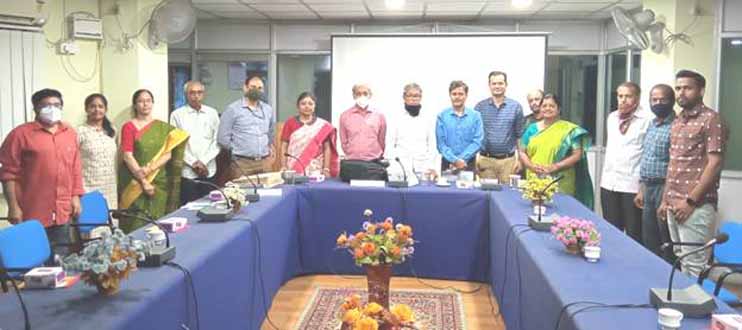

Port Blair, Mar 25: Anthropological Survey of India, Ministry of Culture, Government of India, Andaman and Nicobar Regional Centre, Port Blair organized a guest lecture on the topic “Some Observations and Issues on Adaptive Strategies of Sentinelese of North Sentinel Island”on March 24, 2021 at 03:00 PM in the seminar Hall of the office premises. The lecture was delivered by Mr. A. Justin Rtd Deputy Director, AnSI and the session was chaired by Mr. SA Awaradi, Ex. DC A&N Administration. The session was graced by dignitaries from varied fields. All the staff members of the AnSI, ANRC, Port Blair; and media persons were present on the occasion.
Dr. Nilanjan Khatua, Superintending Anthropologist (C) & Head of Office, AnSI, ANRC, Port Blair, formally welcomed the guests and the audience. Dr. Koel Mukherjee, Anthropologist (P) moderated the session.
Mr. Antice Justin has the experience of conducting fieldwork among various tribes of Andaman and Nicobar Islands including Sentinelese of the North Sentinel Island one of the isolated tribes of the world. He shared excerpts from his many expeditions which was carried out by the Anthropological survey of India to make friendly contacts with the Sentinelese. Since 1974, 22 Pre-tsunami friendly contacts were made with the Sentinelese of North Sentinel Island till April 2003. He mentioned that, ” The Onge are not in touch with the Sentinelese and refer to them as Chanku-ate. As sea levels rose over millennia, any contact they had with neighbouring people on other islands became progressively less frequent”. He beautifully described the stances of Sentinelese accepting various gift articles were distributed such as toys, mirrors, puffed rice, banana, coconuts even boars. Sentinelese tribesmen emerged frontward gleefully to receive those gifts which were lowered from the ship and distributed to them, near Curlew Isle positioned northeast coast of North Sentinel Island.
The Sentinelese has only minimum contact with outsiders. As reflected presently in the Andaman Islands situation till today, they are still as isolated. Their life is mostly untouched ethnically and biologically. He opines that, the unfriendliness of the Sentinelese could be attributed to many unheard provocative encounters with interlopers; hence calling them “hostile” would not be justified. To review the estimated figure, identified locations of their territorial bands, habitats, foraging pursuits, hunting-gathering activities/implements, aquatic crafts and other ground realities etc. can be assessed with utmost care; but not to create any impact of dependency syndrome on their traditional culture as far as practicable sensibly.
He expressed his heartfelt sentiments for primitive and vulnerable tribal groups as Sentinelese, “If one day or the other, we can understand them, and if they have retained a memory of such events, perhaps we will know more, though it is also likely that any increasing contact or global pressurization, is feared, may or will destroy them.”
Mr. SA Awaradi who presided over the session had also been a part of many expeditions as a part of Andaman and Nicobar Administration. He shared the various measures taken by the A & N administration till date to make contacts with the Sentinelese. He also suggested that the Administration could make use of advanced technologies to know about the isolated island without disturbing the islanders. Later the participants engaged into the discussion of their queries.
The programme finally concluded with the formal vote of thanks by Smt. Subhra Bhattacharyya, Assistant Anthropologist (P). On behalf of An.S.I., she extended gratitude towards Mr. A. Justin, Rtd. Deputy Director, AnSI for affirming his presence and for sharing his valuable experience of living and interacting with one of unique community if India. She also thanked Mr. SA Awaradi for accepting the invitation and sharing his views with the audience. Finally, she thanked the audience and the participants for attending the lecture. She also extended her heartfelt gratitude towards all the staff members and the officials of Anthropological Survey of India who worked hard towards making the programme successful. Mr. Mohd Tarique Shah, coordinator, Nehru Yuva kendra, Prof, Manju Nair, Dept of Geography, JNRM Port Blair, Dr. Dipon Sharma, Head of the Dept, Dept of Botany JNRM Port Blair, Dr. Seemanta Kr Deka Head of Departmant of BBA JNRM, PortBlair, Mr. Sanjeev and Rakesh Behera, from Directorate of Census, Port Blair and Devanand E Uikey, Fishery Survey of India Dr. Uttam Singh , Clinical Research Unit, AYUSH were also present in the program.


