
Rabindranath & Vikramaditya
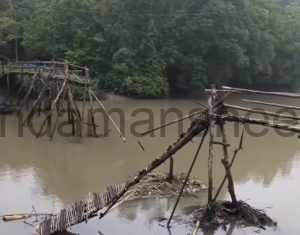
Diglipur, June 8: Heavy rainfall during the night of June 5 once again damaged the temporary wooden bridge connecting Kalighat and Nischintapur in North Andaman, disrupting movement for residents and reviving long-standing demands for the construction of a permanent bridge across the creek.
According to information received, the bridge, which falls under the jurisdiction of Kalighat Police Station, suffered damage due to the strong flow of water in the nallah following continuous heavy rainfall. The temporary structure has frequently been affected during the monsoon season, with similar incidents being reported almost every year.
On June 6, officials from the Assistant Commissioner’s Office, Diglipur, accompanied by Forest Department officials and PRI representatives, reportedly visited the site to assess the situation. During the inspection, local residents were informed that restoration work would be taken up immediately after the water level in the nallah recedes and conditions become safe for repair activities.
For villagers of Nischintapur, however, the latest incident is a reminder of a recurring problem that has remained unresolved for decades. Residents say that despite repeated demands over many years, no concrete plan has been implemented for the construction of a permanent bridge. As a result, almost every monsoon season brings uncertainty and disruption to daily life whenever heavy rainfall causes damage to the temporary crossing.
Nischintapur village, located in North Andaman, is home to around 70 families. The bridge serves as a crucial link connecting the village with Kalighat and other parts of the region. When the bridge becomes unusable, residents are forced to rely on dinghies to cross the creek, often facing considerable inconvenience and risk, particularly during adverse weather conditions.
The situation becomes even more serious during medical emergencies. Villagers point out that patients often have to be transported on makeshift stretchers to reach the other side of the creek before they can be taken to healthcare facilities. During periods of heavy rain and strong water flow, such transfers become extremely difficult and can result in dangerous delays in accessing medical care.
Local residents have once again urged the authorities to consider a permanent solution rather than carrying out temporary repairs after every monsoon-related damage. They argue that a permanent bridge would not only ensure uninterrupted connectivity for the village but would also improve safety, facilitate emergency services, and reduce the recurring expenditure involved in repairing the temporary structure year after year.


