
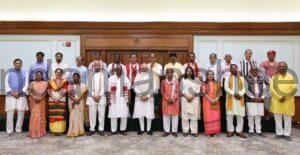
Sri Vijaya Puram, May 29: In the 150th birth anniversary year of Bhagwan Birsa Munda, a delegation of Janajati Suraksha Manch called on Prime Minister Shri Narendra Modi and President Mrs. Droupadi Murmu at Rashtrapati Bhavan in New Delhi on 28 May 2026.
This followed the grand Janajati Samagam 2026 held on 24 May at the historic Lal Kila Maidan, where nearly two lakh tribal brethren from 523 different communities across the country gathered in their traditional attire, folk music, dance, and cultural expressions to reaffirm a just demand that has remained pending for over 75 years. Union Home Minister Mr. Amit Shah, who addressed the Samavesh as Chief Guest, described it as the “Mahakumbh of tribal society.”
The delegation briefed the Prime Minister on pressing legal and constitutional issues concerning tribal welfare. The discussions centred on three core demands. First, a clear statutory definition of “Scheduled Tribe” in line with the Lokur Committee criteria, updated to reflect present-day social realities. Second, a necessary amendment or clarification in the Constitution (Scheduled Tribes) Order, 1950, to address the question of persons who have abandoned their traditional tribal faith, culture, customs and way of life upon conversion, on the lines of the existing provision in the Constitution (Scheduled Castes) Order, 1950. Third, effective protection of the cultural identity and constitutional rights of tribal communities across India, a question the Supreme Court has addressed in Chandramohan v. State (2004) and most recently in Chinthada Anand v. State of Andhra Pradesh (2026 INSC 283).
The Manch pointed out that of a total tribal population of nearly 12 crore, an estimated 1.5 to 2 crore persons have converted to Christianity, and that in many instances converted tribals avail both ST reservation benefits and minority welfare schemes simultaneously, which is contrary to the constitutional principles of equity and social justice. As the late Dr. Kartik Oraon had noted in Parliament in 1970, at that time merely 10% of converted tribals were cornering nearly 70% of ST reservation benefits, while 90% of the genuine tribal population received only 30%. This imbalance has only widened since.
The Manch recalled that during 2009-10, signatures of 27.67 lakh adult tribal members were collected across 26,253 villages in 293 districts of 26 states and transmitted to the President through District Collectors and Governors. Senior tribal leaders, including the late Dilip Singh Bhuria and the late Jagdevram Oraon, had thereafter met the then President Mrs. Pratibha Devi Patil on 18 January 2010 seeking an early decision. Since 2011, the campaign has continued through village contact programmes, district conferences, 5.70 lakh postcards to the Prime Minister, and direct dialogue with nearly 450 Members of Parliament across 21 states.
The delegation urged the President to direct that the matter be referred to the National Commission for Scheduled Tribes for examination and recommendation, and that the Constitution (Scheduled Tribes) Order, 1950 be suitably amended so that ordinary tribal citizens are not compelled to litigate each case individually before competent authorities.
The Manch reiterated that this is not merely a question of reservation or legal interpretation, but one that goes to the heart of the cultural identity, tradition, and existence of crores of tribal people. The tribal society has waited patiently for over 75 years; the time has come for a prompt and positive decision. Satyendra Singh, Dr. Rajkishor Hansda, President, National Co-Convenor, A.B.Vanvasi Kalyan Ashram Janajati Suraksha Manch


