Nishar Mohammed
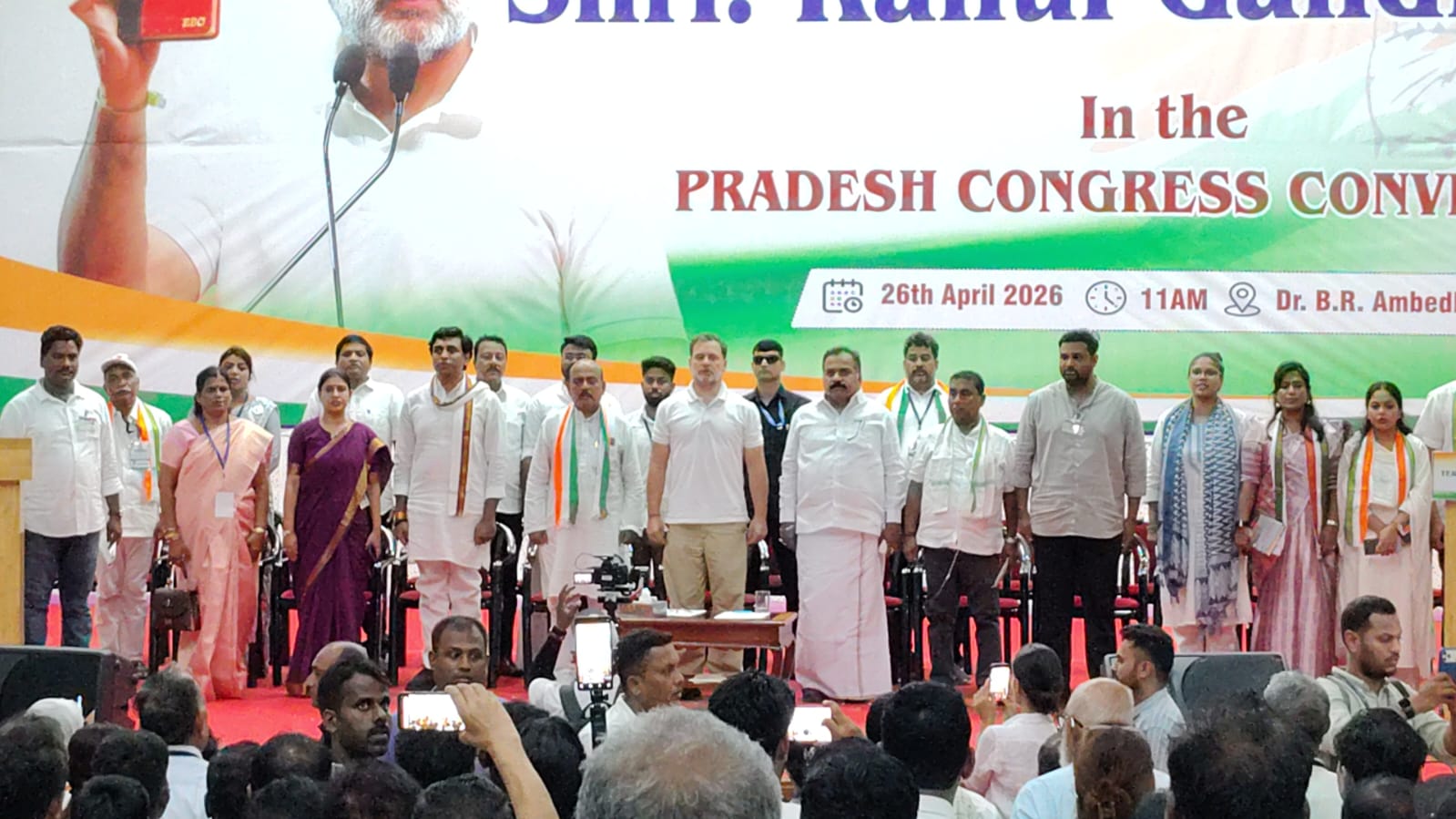
Sri Vijaya Puram, April 26: Senior Congress leader Mr. Rahul Gandhi today reached Sri Vijaya Puram, much to the joy of Congress workers. After arriving, he addressed party workers at the Dr. B. R. Ambedkar Auditorium at Sri Vijaya Puram, where several key issues concerning the Andaman and Nicobar Islands were raised by party leaders and public representatives.
The visit brought multiple pressing concerns into focus, including unemployment, infrastructure gaps, governance issues, and large-scale development projects impacting the islands.
Addressing the gathering, Mr. TSG Bhasker, Chairman of the Campaign Committee of the Andaman and Nicobar Pradesh Congress Committee, highlighted the growing unemployment crisis among local youth. He pointed out that despite limited job opportunities in the islands, a large number of government posts are being filled by candidates from the mainland, leaving local residents at a disadvantage. Referring to a recent recruitment drive in the Animal Husbandry department, he noted that out of 50 posts, only five were secured by island residents, while the remaining positions went to candidates from outside.
Bhasker described the situation as a “reverse migration,” explaining that earlier people from the mainland used to come to the islands in search of jobs, whereas now local youth are being forced to migrate to the mainland in search of employment. He stressed the need for a legal framework to ensure preference for local residents in government jobs, noting that such provisions would require parliamentary approval.
Another major concern raised during the meeting was the implementation of deemed university status in the islands. Leaders stated that the decision, announced in 2018 and implemented recently, was taken without adequate consultation with students and stakeholders. Students reportedly held protests for nearly a month, but their concerns were not adequately addressed. Party leaders called for a review of the policy, emphasizing the importance of inclusive decision-making in education.
The proposed Great Nicobar development project also came under criticism. Leaders alleged that the project could lead to large-scale deforestation and negatively impact indigenous tribal communities. It was pointed out that approximately 130 square kilometers of forest land could be affected. Concerns were raised about environmental damage, displacement risks, and the long-term ecological impact of such large-scale development in a fragile island ecosystem. The issue was described as one requiring careful study and parliamentary scrutiny.
Mrs. Vasantha , Chairperson of the Sri Vijaya Puram Municipal Council highlighted the persistent problem of water scarcity, stating that despite heavy rainfall for most of the year, residents continue to face acute shortages during certain months. In several areas, water supply is reportedly limited to once every few days, causing significant hardship. The need for improved water storage, distribution systems, and long-term planning was emphasized.
Electricity supply was also flagged as a critical issue. Frequent power cuts and unstable supply have been affecting daily life for several years. Residents are reportedly facing ongoing difficulties due to unreliable electricity, and leaders called for immediate measures to strengthen power infrastructure and ensure consistent supply.
Mr. Rangolal Halder, President of ANTCC, raised serious concerns over the growing impact of privatization on employment opportunities in the Andaman and Nicobar Islands. He stated that several government departments, which traditionally provided stable jobs to local residents, are gradually being shifted towards private control. In the absence of industries or a strong private sector in the islands, this transition could severely affect the livelihood of future generations. He also pointed out that local youth face increasing difficulty in securing jobs, both within the islands and on the mainland, due to limited opportunities and structural disadvantages.
He further highlighted issues related to infrastructure and governance, particularly criticizing delays in major road development projects such as the highway connecting Port Blair to Diglipur. Despite significant financial allocations, he alleged that ground-level progress remains inadequate, forcing residents to repeatedly protest for basic road repairs. Mr. Halder also expressed concern over administrative inefficiencies and lack of accountability, stating that corruption and poor implementation of projects have widened the gap between official claims and the reality experienced by the public.
Addressing the gathering, Mr. Rahul Gandhi, Leader of the Opposition in the Lok Sabha, delivered a wide-ranging speech highlighting governance concerns, developmental gaps, and ideological differences.
Mr. Gandhi began by referring to his earlier Bharat Jodo Yatra, stating that in hindsight, its starting point should have been Indira Point in the Andaman and Nicobar Islands before extending to Kanyakumari and Kashmir. He explained that his visit to the islands was prompted by a delegation that met him in Delhi and raised serious concerns regarding the condition of the Nicobar region, particularly the proposed Great Nicobar development project. According to him, members of the delegation, including representatives from tribal communities, warned that the project could cause significant environmental damage and adversely impact indigenous populations. Mr. Gandhi said he decided to visit personally to understand the ground realities.
He alleged that governance in the islands reflects excessive centralization of power, claiming that democratic processes are being undermined. Drawing a parallel with monarchical systems, he remarked that authority appears concentrated in a manner inconsistent with constitutional principles.
Turning to broader national issues, Mr. Gandhi criticized the central leadership, including Narendra Modi and Amit Shah, alleging that decision-making is influenced by external pressures and corporate interests. He also mentioned Donald Trump in the context of international dynamics, suggesting that India’s leadership faces vulnerabilities at the global level. Additionally, he accused major corporate entities, particularly those linked to Gautam Adani, of attempting to acquire land and resources in the islands under the guise of development, potentially sidelining local interests.
Focusing on local concerns, Mr. Gandhi emphasized that the islands are facing serious shortages in basic amenities. He pointed to inadequate access to drinking water, gaps in infrastructure, and the need for better educational facilities. Referring to the implementation of deemed university status, he described it as a poorly planned initiative that has failed to address the actual needs of students. He likened such policy decisions to “illusionary promises,” arguing that they create expectations without delivering tangible benefits.
He stressed that development in the Andaman and Nicobar Islands must be rooted in sustainability and local benefit. Highlighting the region’s natural beauty and ecological significance, Mr. Gandhi said that tourism policies should prioritize long-term gains for residents rather than short-term profits for large corporations. He underscored that the islands’ natural resources—particularly their marine ecosystems and scenic landscapes—should be treated as valuable assets that must be protected and utilized responsibly.
Mr. Gandhi also framed the issues within a broader ideological context, describing an ongoing struggle between two contrasting visions for the country. On one side, he placed the ideology of the Congress, which he said is based on constitutional values, inclusivity, and equality. On the other, he criticized the approach of the BJP and RSS, alleging that it seeks to centralize power and weaken democratic institutions. He claimed that electoral processes have increasingly come under strain, alleging irregularities in several states, and said that the current political contest is no longer merely electoral but ideological in nature.
Highlighting the importance of social harmony, Mr. Gandhi said that India’s strength lies in its diversity. He noted that people from different religions and communities coexist peacefully, and emphasized that this unity must be preserved. Drawing from the teachings of leaders such as Mahatma Gandhi and Guru Nanak, he said the guiding principle should be to counter hatred with love and non-violence. According to him, these values form the foundation of the Congress party’s approach.
He concluded by assuring the people of the islands that he is willing to support their concerns at every level, including raising issues in Parliament and returning to the region whenever required. Mr. Gandhi reiterated that the protection of local resources, empowerment of communities, and adherence to constitutional values would remain central to his political approach.


