
Sanjay Balan
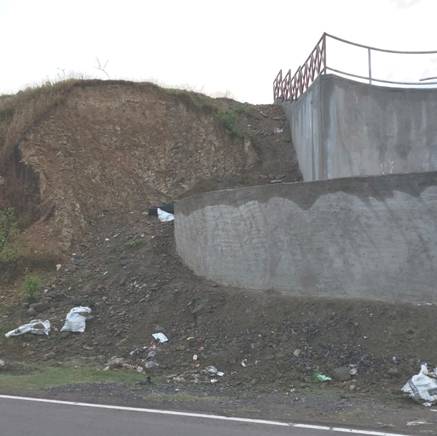
This photograph was taken during morning walk. What it captures is not merely an awkward RCC structure or an unaesthetic cut—it captures a mindset.
A portion of a joggers’ park has been sliced unscientifically to accommodate a belly-shaped concrete mass, leaving behind an exposed vertical hill face that nature never intended to stand at ninety degrees. We are an island territory—hilly, fragile, and shaped over millennia by wind, rain, and slow geological patience. Disturbing this terrain casually is not development; it is short-term convenience with long-term consequences.
Anyone familiar with island geomorphology knows what follows next. The exposed face will not remain stable. Monsoon rains will do what gravity always does. Then, predictably, we will “discover” the problem and sanction a retaining wall. Another estimate, another file, another expenditure—public money spent correcting a problem that never needed to be created.
This is not an isolated case.
Take the road near ANIIDCO. That stretch remained stable for decades. Then came the bright idea of vertically cutting the downslope to accommodate government buildings. The road began sliding—not because nature suddenly changed its mind, but because human intervention disturbed a balance that had held for generations. Traffic was restored after corrective measures, and one hoped that safety and prudence would guide reopening. Instead, urgency arrived with a VIP visit. The road had to open—because optics demanded it (whether it was ready or not, only God knows). Engineering prudence quietly stepped aside.
Contrast this with Tagore College—a rare, beautiful exception. The campus sits gently on its terrain, using natural slopes aesthetically and intelligently. The topography was not butchered; it was respected. I am told the then Principal stood firm against cutting the hill. That vision deserves appreciation, not just for architecture, but for courage. Unfortunately, such outcomes seem to depend on individual conviction rather than institutional policy—which itself tells us where the real problem lies.
In the Andamans, a peculiar lesson has been taught over the years: first flatten the hill, then build; first destroy contours, then pour concrete. RCC is preferred not because it is best for islands, but because once land is levelled, no one can ask uncomfortable questions about what existed earlier. Contours vanish conveniently. Alternate materials, stepped designs, and terrain-adaptive structures are discouraged—not because they don’t work, but because they require thought, supervision, and honesty.
Ironically, the permission regime is most vigilant when an ordinary islander wants to build a modest home. Files move slowly, objections multiply, and regulations become sacred scripture. But when public agencies cut hills or reshape terrain, permissions seem to dissolve into thin air. Development control becomes a citizen-only discipline.
Now we are told that a Master Plan is being prepared for Great Nicobar. Globally, master plans have a long and unhappy history—especially in ecologically sensitive regions. They freeze assumptions, impose rigid zoning, and treat land as a blank canvas. Island nations across the world have moved away from such thinking, opting instead for adaptive, incremental, terrain-first planning. Here, however, we appear determined to relearn old lessons the hard way.
Master plans rarely protect nature; they often protect paperwork. Citizens suffer under their rigidity, while ecosystems continue to erode quietly in the background.
The common thread in all these examples is simple: lack of humility before terrain. Where humility existed—as at Tagore College—the result is stability and beauty. Where arrogance prevailed—vertical cuts, rushed openings, rigid plans—the damage is immediate or inevitable.
Islands are not miniature mainlands. They demand a different ethic, one that asks first what must not be touched rather than what can be built. Development here should adapt to land, not force land to adapt to development.
Otherwise, we will continue building walls—retaining walls, boundary walls, and eventually excuses—each more expensive than the last, each correcting a mistake we did not need to make in the first place.
And someday, when the hills are gone and the repairs never end, we may finally ask the right question—just a little too late.


