Debkumar Bhadra
It is believed early roads were the animal trails which human counterparts followed. Over the years those natural trail took the form of smooth, paved roads which in the modern sense meant an unhindered right of way. It is for this reason a road now includes bridges, tunnels, junctions, crossings, interchanges and a whole lot of other supporting structures that makes travel between places and destinations easy, convenient and a lot faster.
A road although is primarily meant to provide unhindered right of way, but as roads became better and smoother, increasing traffic and the commuting speed contributed towards raised safety concerns. Certain physical constraints such as speed breakers, rumble strips and or width restrictions therefore had to be introduced at certain locations to ensure orderly movement of traffic and improve the safety of road users.
The Indian Road Congress (IRC), a premier technical body set up by Govt. of India, incorporated suitable guidelines (IRC: 99-1988) containing the general conditions, scope and detailed specifications for design, plan of placement, sign postings, markings, maintenance and other issues relating to use of speed breakers for Indian road conditions.
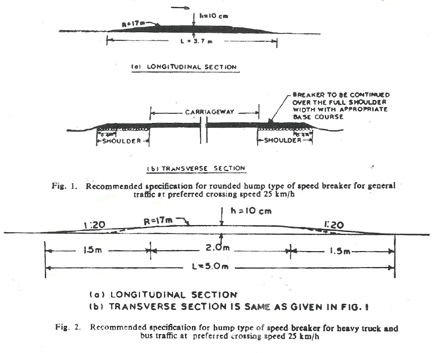
Article 5.1 of the IRC guideline reads : Speed breakers are formed basically by providing a rounded (of 17m radius) hump of 3.7m width and height of 0.10m (ie 10cm at the centre) for general traffic. The document also specifically mentions Speed Breakers should be so designed that it should not cause damage to the vehicle nor cause excessive discomfort to the driver and passengers while crossing a hump at the preferred speed. Neither should a hump give rise to excessive noise or cause harmful vibrations to the adjoining buildings or affect nearby residents.
In contrast to the IRC guidelines, the speed breakers that dot our islands roads tells a horrible story. Readers would agree, except a couple of speed breakers on each of the road culminating at Goal Ghar crossing, almost all other speed breakers in the town are a motorists nightmare. Situation in rural areas are further worse.
Not only the speed humps are defective in terms of shape and size, the (retro-reflective) warning sign (40m ahead of speed breaker), marking with (yellow and white) paints which serve as a visual warning are rarely seen. Poorly lit roads and absence of safety features take motorists by surprise. The non-suspecting ones encounter these surprise elements (read defective speed breakers) with a large “thud” causing damage and discomfort to the vehicle and its occupants. Auto rickshaws, small passenger cars and two wheelers are the worst affected.
It is true speed breakers play an important role in controlling vehicular speeds, hence considered a necessity at some of the roads. But failure to design them properly hampers smooth flow of traffic, causes excessive discomfort and or damage to the vehicle besides posing safety threat for other road users.
Let me quote the tragic death of Tamiz Mani (27), son of State Cooperation Minister in TN, who died after his motorbike hit a speed breaker on NSC Bose road near Madras High Court on 25th June, 2012. Chennai Corporation launched a massive survey and found that there were over 400 speed breakers within the city limits that were badly designed and do not adhere to IRC standards. The defective speed breakers were therefore redesigned to IRC standards and the unauthorized ones removed forthwith.
The point to ponder is for a city like Chennai which has over a crore vehicles, it took 3 days (following the tragic death of Tamiz Mani) to survey, remove and or redesign over 400 defective speed breakers. What should it take A&N Islands, which has a road length of just over a thousand kilometers and 80200 vehicles?
Certainly not a repeat of Tamiz Mani type incident – isn’t it! (Debkumar Bhadra, Shore Point, Bambooflat, S Andaman-744107, Email : debkumar_bhadra@yahoo.com)


