
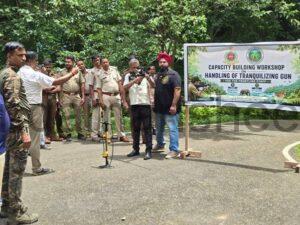
Sri Vijaya Puram, July 1: The Department of Environment and Forests, Andaman and Nicobar Administration, organised a one-day Capacity Building Workshop on the handling of tranquilizing guns for frontline forest staff at the Biological Park, Chidiyatapu, today. The workshop aimed to enhance the technical competence and operational preparedness of personnel involved in wildlife rescue, immobilization, translocation, conflict mitigation and conservation across the islands.
The programme was inaugurated by Shri Ravi Horo, IFS, Principal Chief Conservator of Forests (Wildlife)-cum-Chief Wildlife Warden, in the presence of Dr. S. Dinesh Kannan, IFS, Chief Conservator of Forests (Wildlife) and Shri Joju P. Alappat, IFS, Conservator of Forests (Wildlife).
The workshop witnessed participation from officers, veterinary compounders, mahouts and frontline forest staff representing territorial and wildlife divisions of South, North and Middle Andaman districts.
During the programme, a pamphlet titled “Safe Tranquilization Practices”, prepared by the Biological Park, Chidiyatapu, was released to serve as a practical field guide for the safe and scientific use of tranquilizing equipment during wildlife operations.
Addressing the gathering, the Chief Wildlife Warden highlighted the importance of continuous capacity building and the adoption of advanced scientific techniques in wildlife conservation. He said well-trained personnel equipped with modern techniques and specialised equipment are essential for ensuring the safety of both wildlife and field staff during rescue and management operations.
Technical sessions were conducted by experts from BMR Wildlife Service, Indore, covering the safe handling and maintenance of tranquilizing guns, wildlife immobilization techniques, dosage calculations, field safety, emergency response protocols and post-immobilization monitoring. The workshop also featured interactive discussions and hands-on demonstrations.
The workshop concluded with a reaffirmation of the Department’s commitment to strengthening wildlife conservation through continuous capacity building, adoption of modern technologies and promotion of safe, ethical and scientific wildlife management practices.


