
Akriti Soreng
Many Islanders don’t know this, but Andaman and Nicobar Islands once had something close to local legislature: the Pradesh council. It existed from 1979 to 1994 then it was abolished, leaving the Island under centralized governance.
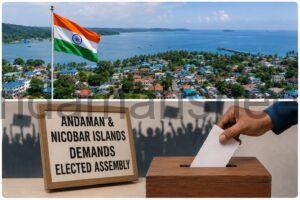
Decades later the call for local democratic representation grows stronger, a crucial question remains Why a territory so central to India’s security, culture, and ecology still doesn’t have its own legislative assembly.
How is Andaman and Nicobar governed today?
The Andaman and Nicobar Islands functions as a union territory of India and are administered directly by the Central Government through a Lieutenant Governor, who acts as a chief administrator of the Island. In the absence of legislative assembly, executive authority rests largely with the LG, administration is actively managed through various government departments headed mainly by IAS and IPS officers appointed from mainland. The Island have one member of parliament in Lok Sabha but no elected body in local legislative assembly that can make law, hold the administration accountable or represent the aspirations of local’s in structured democratic forum.
What’s the political mood in Andaman?
The demand for a legislative Assembly or a Pradesh council is not new or narrow it’s long-standing and received cross -party support over the years.
In 2017 political parties across the Island came together unanimously to advocate for the creation of joint formed a joint action committee for this purpose. Later in 2021, the Dweep Janta Party a regional formation rooted in Island specific politics, submitted a memorandum to Home Minister demanding a legislative Assembly or restoration of the Pradesh council arguing that without it “ democracy cannot be established in Andaman and Nicobar Islands.” More recently, in January 2025, the CPI(M) state conference adopted a resolution calling for a legislative Assembly on the model of Puducherry highlighting that even after 77 years Independence the Island still remains without essential democratic institution.
What exactly is the difference between an Assembly and Pradesh Council?
Legislative Assembly, would grant Andaman and Nicobar Islands the status of union territory with a legislature, similar to Delhi capital territory, or Puducherry. Under this model, an elected assembly would have power to make law on specific subjects (e.g local development , land, tourism, welfare) while certain matters ( defence, public orders, communications) would remain under Central Government control.
Pradesh council (1979-1994) in the Andaman and Nicobar Islands was a semi representation body made up of both elected and nominated members. It had only limited legislative authority and mainly function in advisory role. Unlike full-fledged state legislature, it didn’t oversee a council of ministers accountable to it. Later the council was dissolved in 1994, leaving the Island without any legislative body. Functioning of semi legislative body enables transparent, open house discussion, and execution with counselors wielding greater autonomy and accountability that other representatives. It’s restoration has been unanimously demanded by all political parties in Andaman essential for establishing meaningful democracy in the Island.
Why a legislative Assembly or Pradhan Sabha necessary for Andaman?
As of today, People of Andaman have no elected representative who can make law, scrutinise the budget, question the administration or hold bureaucrats accountable locally. The absence of a legislative body is not merely a procedural gap it’s the real consequences for the people of Andaman. All the major decisions affecting local livelihood, indigenous tribal communities, land, tourism regulation, and Island connectivity are taken by officers posted from mainland many of whom may have little familiarity with the ecological condition, sensitivities, or livelihood patterns.
A territory Without a democratic framework, hence the fate of Islanders is unknown. There is zero representation for the voices, the demands, and the aspirations of local population in any binding legislative forum. There is a democratic deficit, where the local representative can question the budget allocation, demand accountability for delays in infrastructure project, or push back against the policy that affects the lives.
The current population of the island exceeds five lakh a figure larger than any constituencies that return MLA’s in other states. Denying such a population any form of local representation is hard to justify in democratic nation. Puducherry, which has comparable population and union territory status has its own legislative Assembly, chief minister and cabinet. Delhi too carries UT status but granted under special status because it’s the national capital, Jammu and Kashmir was a state legislative assembly until 2019, but after reorganization it became UT but retained a legislative Assembly. So why not Andaman and Nicobar?
What could a Pradesh Council or Assembly actually do for the people of Andaman?
A Legislative Assembly or Pradesh Council would transform governance in Andaman in tangible, everyday ways. An electoral body or advisory capacity could establish democratic legitimacy and public participation who can speak for Islanders a transformed governance could provide in several ways.
Elected representative would have direct accountability the voter, could debate or review the allocation of funds ensuring the development reaches remote location than being concentrate to on place.
Citizens could engage through there participation and representation in policy debates. Open legislative function would make governance more transparent. Andaman’s identity is shaped by freedom fighters, settlers, indigenous tribes, and a unique diversified community deserves political recognition at home not just a single voice in 543 member in Lok Sabha.
On the subject like local fisheries, tourism regulation, water management, and Island connectivity, locally enacted law would grasp the situation more relevantly noting the sensitivity.
Are there any counter-arguments against granting an assembly to Andaman?
Opponents of the legislative Assembly often cite some concerns, Andaman’s India’s most easternmost strategic outpost, bordering the bay of Bengal and key sea lanes. Home to military bases, coastal security Installation, and proximity to international borders. Also the scattered population across 31 inhabited Island, makes logistically difficult to conduct election, manage representation, or to deliver performance. Tribal groups (Jarawa, Onge, Sentinelese) Centre might fear that local political pressure might lead to exploitation to tribal areas for tourism development.
On strategic, Puducherry has proved that a union territory can have full fledged functioning elected assembly while the Central Government retains the control over defence, public orders and communications. Andaman’s military installations and coastal security infrastructure would remain entirely under central control, exactly as they do today. A local assembly debating fisheries policy or tourism regulation poses no threat to a naval base. The two can coexist, and in Puducherry they have for over six decades without a single security incident attributed to the existence of its legislature.
On logistics, India has conducted elections in the Himalayan heights of Ladakh, the dense forests of Bastar, and the remote islands of Lakshadweep. Thirty-one inhabited islands with modern communication links are not beyond the Election Commission’s reach. Logistical difficulty has never been accepted anywhere in India as a justification for denying democratic representation — and it should not be accepted here either.
On tribal protection, this concern ironically, is a stronger argument for an assembly than against it. Mainland-appointed bureaucrats rotate every two to three years, often with little knowledge of the Jarawa, Onge, or Sentinelese communities’ histories or vulnerabilities. A locally elected assembly, accountable to the people of Andaman, would have far greater incentive and contextual understanding to protect tribal welfare than any officer posted temporarily from the mainland. The tribal protection argument, properly considered, is a reason to grant representation — not to withhold it.
Puducherry Model – A template for Andaman
Puducherry former French colony later a union territory with a legislature since the 14th constitutional Amendment of 1962. It has unicameral legislative Assembly with 30 elected members and 3 nominated members, a chief minister and a council of ministers. The LG of Puducherry act as administrator and represents union government, but the elected government hold executive sate authority list subjects. Importantly the Central Government retains the control over the defence, public orders and communications.
This model gives optimistic visionary template for Andaman. It respects union territory characteristics, maintains the Central Government oversight on strategic matters, and restores the democratic governance to the people. The Private Member’s Bill introduced in Parliament in 2021 explicitly seeks to replicate this framework for Andaman through Article 239C.
Why Both Models Are an Optimistic Solution for Andaman’s Future Governance?
A Legislative Assembly and a restored Pradesh Council are both genuine solutions not because they are the same, but because they serve different purposes. One is the immediate step; the other is the long-term destination.
A full Legislative Assembly offers Andaman what Puducherry already has — a permanent, constitutionally protected body with real lawmaking power, a Chief Minister, and structured accountability. Unlike the Pradesh Council, which was dissolved by administrative decision in 1994, a Legislative Assembly cannot simply be wound up at the Centre’s convenience. It ends the democratic deficit permanently.
A restored Pradesh Council, while less powerful, is far more politically achievable in the short term. It requires no constitutional amendment, carries historical precedent from its own fifteen years of functioning in Andaman, and can serve as a transitional foundation — building democratic culture and institutional trust before the Islands advance to a full assembly.
What is the significance of the demand for an Assembly beyond politics?
The demand for an Assembly or Pradesh council is more than politics it’s about local representation and self determination. The absence of elected representation has already created a democratic deficit the marginalizes the Islanders and prevent effective addressing to local challenges.
Political parties, civil society organisations must continue to build consensus around the demand for democratic representation. The unified demand from all political parties has already created a strong foundation to this address. Democracy is not a privilege to be extended when convenient. For the people of Andaman and Nicobar who have safe guard the islands heritage and identity for generations.
The Islands gave India its first unfurling of the Tricolour during the freedom struggle. It is time India gave the Islands their democratic voice. (Note: This Article is written by Akriti Soreng, Intern, Andaman Sheekha Daily)


