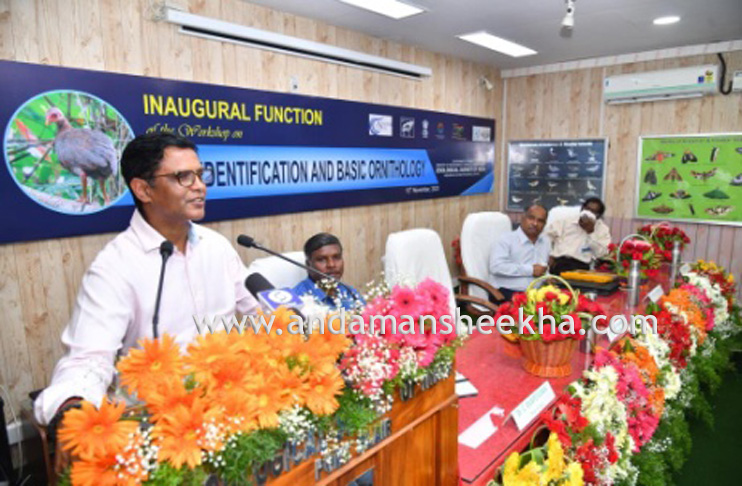

Port Blair, Nov 15: Two week workshop on Bird Identification and Basic Ornithology under theAccelerate Vigyan, Science & Engineering Research Board (SERB), Departmentof Science and Technology, Ministry of Science and Technology, Governmentof India has inaugurated by the Chief Secretary, Andaman and NicobarAdministration in Zoological Survey of India, Andaman and Nicobar RegionalCentre, Port Blair on 15.11.2022.
Mr. Keshav Chandra, IAS, Chief Secretary, Andaman and NicobarAdministration was the Chief Guest, while Dr. R.S.C. Jayaraj, IFS,Principal Chief Conservator of Forests, Andaman and Nicobar Islands, andDr. P. Vijayachari, Director, ICMR-Regional Medical Research Centre, PortBlair were the Guests of Honor. The programme was also attended byOfficers from Department of Environment and Forests, Botanical Survey ofIndia, Fishery Survey of India, Anthropological Survey of India, Andamanand Lakshadweep Harbour Works, Pondicherry University and GB PantHospital. The Inaugural Function was started with a prayer song andlighting of traditional lamps. About 31 participants have registered forthis two week workshop.
Addressing the gathering, the Chief Secretary thanked the Department ofScience and Technology, Government of India for taking the initiative inproviding skill training under Accelerate Vigyan. In his address, heelucidated the most basic of bird watching definition, aside from simplywatching or listening to birds, most birders go a few steps by documentingtheir observations, identifying the birds, and sharing their findings withfellow bird enthusiasts. The Chief Secretary also mentioned that birdingmeaning is inextricably rooted in an appreciation and sense of wonder atthe avian species in bird watchers and this is what everyone from novicebird watcher to expert birder has in common. He also highlighted how heexpanded his species list with every trip and experience birding indifferent habitats with Dr. C. Sivaperuman, Officer-in-Charge, and ZoologicalSurvey of India. Landscape photography is his passion that has taught him towake up before sunrise, and later he has shifted to Bird Photography also.He has beautifully described how bird watching can shape an individual’spersonality by developing the perseverance and patience of the watcher. Heconcluded by giving remarks upon the serenity and pristine beauty of theseislands which attracts many bird watchers and flourishes an unimaginablebiodiversity and wished ZSI for taking up this kind of activities.
The Guest of Honor Dr. R.S.C. Jayaraj, IFS, Principal Chief Conservator ofForests, Andaman and Nicobar Islands felicitated the gathering. In hisfelicitation address, he accentuated that the trainees must know theecological as well as the economic aspects of bird watching. He highlighted the collaboration between the Forests Department and ZSI in whichthey have carried out surveys from Landfall to Indira Point. The PCCF also emphasized bird tourism and the value of education in thisindustry. He also mentioned to the students about the various new jobopportunities waiting in the tourism industry and others etc. He portrayedthe incredible significance of knowing the worth of bird watchers invarious fields like conservation, management and agriculture etc. of whichthose will be achieved only by imparting proper training of the localcommunity.
Dr. P. Vijayachari, Director, ICMR, welcomed the gathering with hisbeautiful felicitation address. In his speech he mentioned the significanceof Bird identification in basic and applied sciences and how these twoembed into medical sciences. He signified the urgency in the need of morespecialized experts in the field of ornithology in our country. Along withthe experts he put forward the importance of youth of these islands insimilar kinds of programmes. He emphasized the status of inter-sectoralcoordination between Animal Science, Veterinary Science, Health Scienceand local Community. The speaker also cited the interconnection betweenZoonotic disease and biodiversity. The speech included various mentions ofleptospirosis and its status in these islands and how it has beeneradicated with the help of various institutions. Lastly, he concluded byimplying about the collaborative projects between various institutionswithin and outside these islands and their role in understanding theecology and economy of island biodiversity.


