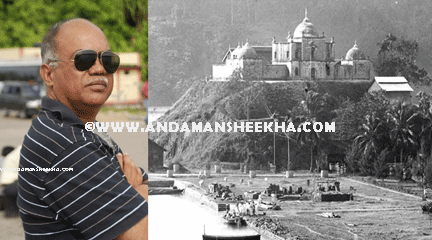
N. Francis Xavier
It was a few minutes before 6 p.m. on 9th July 1880. The lone sentry on ViperIsland jetty paced up and down the wharf, his rifle on his shoulder, waiting for the second sentry, who will relieve him at six.
A sepoy of the 23rd Madras Native Infantry Battalion was sitting on one end of the jetty, casting a fishing line.
All was quiet on Viper, the “Hell on Earth” of Andamans — no cries of convicts getting flogged – no hangings at the mausoleum-like, three-domed gallows on the hillock right behind the jetty.
Tied up along the wharf was the whaler of M.V. Portman, the officer in charge of the aboriginal Andamanese tribe. It was the best boat in the settlement, extremely seaworthy, with endurance to stay at sea for long periods. Used by whaling ships for chasing and harpooning whales it has an excellent reputation as a good sea boat. Capable of using oars and sails it was almost unsinkable. About a hundred years earlier Captain William Bligh of the Bounty was put in one such boat after the mutiny on the ship. He and eighteen others sailed thousands of miles in the Pacific to reach Timor safely, thanks to the excellent seamanship of Bligh.
Portman used the boat to make ‘contact visits’ to the tribal areas. He had it equipped for long trips. It was well stocked with camping equipment, food and water. He was to leave on one such visit the next day. The boatmen have already drawn their rations for a prolonged visit.
Seven men walked nonchalantly towards the boat. Their uniforms proclaimed that they were ‘ticket of leave’ men — convicts who have served long sentences and were granted conditional release, which gave them freedom of movement within the settlement. A wooden ‘ticket’ attached to an iron ring around their necks was inscribed with their number, term of imprisonment and their ‘ticket-of-leave’ status.
The men brought oars, crutches, cushions, tiller, rudder, a canvas awning and a folded sail. Their leader, obviously a seasoned sailor, directed them to lay out the materials and stow them neatly in their respective places in the boat. It was clear from their movements that they had good training in seamanship. Their rations and a portable stove have also been stowed in the stern of the boat. The boat was being prepared for sea the next day.
Hemraj, the coxswain, was well known to the sentry. In fact everyone in the settlement knew him as the best boatman in Port Blair. He had the handsome, slightly mongoloid looks of the natives of Nepal. A pleasant smile played on his face all the time. A life-convict, he was sent on a sentence of transportation for life to the Andaman Islands.
The crime for which he was transported was ‘dacoity’, a vague term under which anyone who protested against the government could be sent away for protracted terms of transportation beyond seas. Hemraj always maintained that he was the victim of a conspiracy by his own relatives who wanted to appropriate his property. He had already served twenty years, spending the first six months in solitary confinement. He earned his ticket of leave because of his good behavior and the skill with sail and oar.
Unlike most other convicts around him Hemraj was not a murderer. Generally of a cheerful nature he was a bit upset of late when his petition for absolute release had been turned down. Lt. Col. Cadell, who took over as Chief Commissioner a few months ago did not recommend his release citing his being sentenced in a case of ‘dacoity’. Hemraj felt genuinely aggrieved that he was not rewarded for his unblemished, long service, while others, who committed more heinous crimes, have been pardoned. Had Gen. Barwell, the former Chief Commissioner, been there he would have been a freeman by now, he felt.
The other crew consisted of two life convicts and four term convicts. All were able-bodied, at the peak of physical fitness and well-trained in obeying the pulling orders of the coxswain. Quickly they fitted the brass crutches and laid the oars neatly in their respective places. They fitted the footboards in their slots, placed the cushions on the thwarts, and stowed the awning and sail under them. The sentry knew they were going out for a long sail the next day. He kept pacing the length of the jetty, waiting for his reliever.
After fitting out the boat Hemraj pulled it by the head rope to the boat landing and tied it up to the bollard. He hailed the sentry and told him to look after it while they go to get their dinner.
The sentry protested. Leaving a boatunattended, with oars and oarlocks in place was strictly forbidden. He told Hemraj to take them back and deposit them in the boathouse. Hemraj got into an argument with the sentry, engaging his attention and drawing him to the end of the jetty, where the steps led down to the boat.
Suddenly one of the men who accompanied Hemraj sprang from behind and hit the sentry on the head with the heavy tiller of the boat, while another grappled with him for his rifle.
As the sentry fell into the water his Snider-Enfield carbine and the ammunition pouch were grabbed by the convict. Before the sentry could realize what was happening the men jumped into the boat and took their respective places on the thwarts. The oars were shipped, their blades vertical; strong hands gripped the shaft; “give way” Hemraj shouted; the men bent all the way forward and leaped back with each stroke. The whaler streaked off into the gathering darkness, with Hemraj at the helm. (to be continued on Next Monday).


