Navneet & Vikramaditya
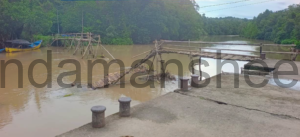
Diglipur, Nov 25: For around 70 families living in Nischintapur village under Kalighat Gram Panchayat in North Andaman, crossing a creek to reach essential services remains a daily challenge, with the situation becoming particularly difficult during the monsoon. What should have been a basic road connectivity facility has instead turned into a recurring struggle for survival, as the temporary wooden bridge connecting Nischintapur with Kalighat gets damaged almost every year following heavy rainfall and strong water currents.
The consequences are not limited to inconvenience. When the temporary bridge becomes unusable, villagers are forced to depend on dinghies to cross the creek. The situation becomes particularly distressing during medical emergencies, when patients have to be carried on makeshift stretchers to reach the other side before they can be taken to healthcare facilities. Schoolchildren, elderly residents, pregnant women and people requiring urgent medical attention are among those who bear the greatest burden of this inadequate connectivity.
The issue has once again been brought to the attention of the administration, with Kalighat Gram Panchayat Pradhan Mr. Ashit Kumar Mandal recently writing to the Lieutenant Governor, Dr. Dinesh Sharma, seeking intervention for the construction of a permanent road and reinforced cement concrete (RCC) bridge connecting Nischintapur with Kalighat. In his representation, the Pradhan has also sought the necessary clearances and no-objection certificates from the concerned Forest and Environment authorities to facilitate the long-pending project.
Talking to Andaman Sheekha Daily, Pradhan Mr. Ashit Kumar Mandal said that the recurring damage to the temporary bridge has become an almost annual affair, particularly during periods of heavy rainfall.
“Every year, during heavy rainfall, the temporary bridge gets damaged. After that, the Panchayat, with the support of the Forest Department and other departments, makes efforts to construct or restore a temporary bridge. People somehow manage to resume their daily activities. But the following year, the same thing happens again. This cycle has to stop. We cannot continue building a temporary bridge every year. A permanent RCC bridge is the only lasting solution,” the Pradhan said.
He further explained that whenever the issue of permanent construction is raised with the concerned authorities, the response has been that the necessary Coastal Regulation Zone (CRZ) clearance is awaited, particularly because the proposed alignment involves an environmentally sensitive area with mangroves. While acknowledging the importance of environmental protection and statutory clearances, the Pradhan said that the matter requires coordinated and time-bound intervention by the concerned departments rather than allowing it to remain pending indefinitely.
The villagers, meanwhile, believe that the issue could be resolved within a few months if the administration genuinely makes it a priority and all concerned departments work together. According to them, the fact that Nischintapur is a remote village, with a relatively small population and limited public representation, has contributed to their problems receiving inadequate attention.
Residents feel that their geographical isolation has also translated into administrative neglect. They believe that because the villagers have little voice at higher levels, their long-standing demand has failed to receive the attention it deserves from the administration and senior political leadership. For them, the repeated restoration of a temporary bridge is no longer an acceptable response to a problem that has continued for decades.
Senior citizens believes, that the environmental clearance issue also deserves attention. The Island Protection Zone Notification, 2019, provides for the case-by-case consideration of certain essential public infrastructure projects, including bridges and roads required by local inhabitants, by the competent Coastal Zone Management Authority in applicable regulated areas. The notification also lays down procedures for examination and recommendations on proposals seeking clearance. However, the precise applicability and approval requirements depend on the site’s coastal classification and the nature of the proposed construction.
Against this background, villagers feel that the administration should take up the matter on priority, coordinate with the Forest and Environment authorities, prepare the necessary technical documents and pursue the required clearances with the competent authorities. They believe that environmental safeguards and the development needs of local communities should be addressed together rather than allowing the absence of connectivity to become a permanent feature of village life.
For the residents of Nischintapur, a permanent bridge is not merely another infrastructure project. It is a lifeline connecting them to education, healthcare, markets and other essential services. They are not asking for repeated temporary arrangements every monsoon; they are asking for a permanent solution that will spare future generations from the same hardships.
The question that continues to trouble the villagers is simple: if a temporary bridge can be restored almost every year through the combined efforts of the Panchayat and concerned departments, why has a permanent bridge remained elusive for decades?
The people of Nischintapur now expect the Lieutenant Governor and the senior administration to intervene, bring all concerned departments together and move the project towards a time-bound resolution. For a village that has waited for decades, another monsoon of temporary repairs is simply not an answer.