
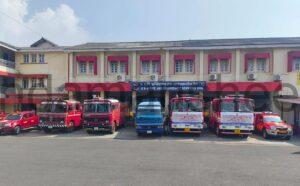
Sri Vijaya Puram, October 26: Former Councillor of Ward No. 23, Sri Vijaya Puram Municipal Council (SVPMC), Mr. Sanjay Meshack, has submitted public objections and suggestions on the Draft Andaman and Nicobar Islands Fire and Emergency Services Rules, 2026, to the Superintendent of Police, Fire Brigade Department, South Andaman District, Sri Vijaya Puram, in the larger public interest.
In his letter, Mr. Meshack stated that fire safety is essential for protecting human life and property, and strengthening the Fire and Emergency Services is a welcome step. However, the proposed Rules should be practical, affordable and proportionate to the actual risks involved. Regulations intended to protect citizens should not impose excessive financial burdens on ordinary homeowners, small establishments and community organisations, particularly in the geographical and economic circumstances of the Andaman and Nicobar Islands. He requested the Administration to consider his recommendations before finalising the Rules.
On exemption for individual residential houses, he suggested that ordinary individual residential houses below 500 square metres, occupied by a single family, should be exempt from routine mandatory Fire Safety Certificates, certification charges and any additional fire safety levy proposed under the Rules, subject to applicable law. Individual houses should not be subjected to the same requirements as commercial complexes, hotels, hospitals, high-rise buildings or industrial establishments. Basic fire prevention, safe electrical practices and public awareness should be encouraged, and intervention may be necessary where a specific and serious fire hazard exists, in accordance with law.
Seeking separate provisions for small buildings and community facilities, he said small buildings, neighbourhood community halls, public halls, residents’ association halls, small marriage halls and other community facilities should be classified according to their actual occupancy and fire risk. The requirements should consider the building’s floor area, height, maximum number of occupants, number of exits, evacuation arrangements and frequency of public gatherings. A small community hall accommodating a limited number of people should not automatically be subjected to the same expensive installations required for a large convention centre or a high-occupancy public auditorium. At the same time, halls used for large gatherings should have suitable exits, emergency lighting, appropriate fire extinguishers and other safeguards proportionate to their occupancy and risk.
Calling for risk-based firefighting equipment, he said the Rules should prescribe graded fire safety requirements instead of mandating fixed firefighting pipelines, pumps, hose reels and elaborate installations in every building irrespective of its size and use. He suggested basic fire prevention and suitable portable fire extinguishers for individual houses; appropriate portable extinguishers, safe electrical installations and unobstructed exits for small shops and low-risk buildings; suitable extinguishers, clear exit routes, emergency contact information and other measures appropriate to occupancy for small community halls; fire alarms, emergency lighting, marked exits, evacuation plans and additional systems as prescribed by applicable standards for large public halls, auditoriums and high-occupancy buildings; and enhanced fire protection according to the nature of the hazards for high-risk commercial and industrial premises. Requirements should be based on recognised technical standards and actual risk rather than imposed indiscriminately.
On Rule 12, he sought a reduction of the proposed inspection fee, stating that the proposed fee of Rs. 20 per square metre, as understood from the draft, may impose a substantial financial burden on homeowners, small building owners and community organisations. He requested that the fee be reduced to Rs. 10 per square metre, with suitable concessions or exemptions for eligible low-risk premises. The fee structure should be proportionate to the size, occupancy and risk category of the building, and a small community hall or neighbourhood facility should not face an unreasonable financial burden merely because its built-up area exceeds that of an individual house.
He also sought a review of the proposed fire tax, saying the proposed additional fire tax, calculated at one per cent of property tax, should be reconsidered, particularly for ordinary residential houses and small community facilities. Fire and emergency services are essential public services and should be funded primarily through the public budget. Any additional levy should have a clear legal basis, a transparent calculation method and a proportionate structure. Ordinary individual residential houses should be considered for exemption from the proposed levy, subject to applicable law, and appropriate concessions should also be considered for eligible community organisations and small public facilities.
Regarding existing buildings and municipal building plans, Mr. Meshack pointed out that many buildings in the islands were constructed before the introduction or implementation of the relevant municipal building bye-laws, and owners of such buildings may not possess municipal building plans because these were not required or issued at the time of construction. It would therefore be unreasonable to impose blanket retrospective building-plan requirements on all existing buildings merely as a condition for fire safety compliance. The Rules should clearly distinguish between new construction and existing buildings; building-plan approval requirements should apply prospectively in accordance with the applicable law, while existing buildings should be assessed on their actual fire safety risks. Where a Fire Safety NOC is legally required, the competent Fire Department should assess the applicable safety requirements without insisting on unrelated historical documents that the owner was never required to obtain.
On Rules 16 and 18, he sought reasonable time for compliance, saying the proposed six-month compliance period for existing buildings should be extended to at least two years wherever substantial modifications, equipment procurement or structural improvements are necessary. A phased compliance schedule should be introduced, giving homeowners, small establishments and community organisations sufficient time to arrange funds and complete the necessary work. A Fire Safety Certificate should ordinarily remain valid for at least ten years, subject to applicable standards, maintenance requirements and risk-based inspections.
Seeking protection against arbitrary sealing, he said sealing a building may deprive residents of their homes, interrupt community activities and cause serious financial hardship. Except where immediate action is necessary to address an imminent and serious threat to life, sealing should be treated as a last resort. The competent authority should ordinarily issue a written notice, specify the deficiencies, allow a reasonable period for rectification, provide an opportunity to be heard and issue a reasoned order, and an appropriate appeal mechanism should also be available. Minor or rectifiable deficiencies should not automatically result in the closure of a building when effective corrective measures can reasonably be undertaken.
For transparent inspection and certification, he said the Rules should prescribe clear inspection procedures, reasonable charges and category-wise standards for different types of buildings. The qualifications and responsibilities of private inspection agencies should be transparent, and building owners should receive written reports identifying the deficiencies and corrective measures required. Unnecessary repeat inspections, duplicate certification and arbitrary assessments should be avoided.
On public consultation and awareness, he said that before finalising the Rules, the Administration should invite representations from elected representatives, resident welfare associations, community organisations, traders, architects, engineers and other stakeholders. A simple public guidance document should explain which buildings require Fire Safety Certificates, the equipment required, applicable fees, compliance timelines and the procedure for appeal. Special consideration should be given to the islands’ geographical conditions, the cost of equipment, the availability of qualified technicians and the financial circumstances of ordinary residents.
In view of the above, Mr. Meshack requested the Administration to exempt ordinary individual residential houses below 500 square metres from routine mandatory fire certification and the proposed additional fire levy, subject to applicable law; introduce separate, risk-based standards for small buildings, community halls, public halls and large gathering venues; reduce the proposed inspection fee from Rs. 20 to Rs. 10 per square metre; avoid unnecessary retrospective municipal building-plan requirements for existing buildings where such plans were not required under the applicable law at the time of construction; extend the compliance period for existing buildings requiring substantial modifications to at least two years; provide reasonable certificate validity, transparent inspection procedures and safeguards against arbitrary sealing; and publish clear, affordable and category-wise fire safety requirements before finalising the Rules.
Fire safety and public welfare are complementary objectives. A fair and practical regulatory framework should ensure stronger protection where risks are high while avoiding unnecessary expenditure and hardship for ordinary homeowners and community organisations, he said, expressing hope that the suggestions will receive due consideration and that the final Rules will safeguard public safety while remaining affordable, equitable and suitable to the unique circumstances of the Andaman and Nicobar Islands.


