
Staff Correspondent
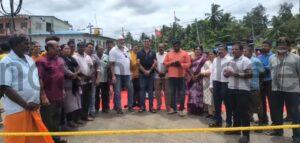
Campbell Bay, July 27: Public anger over the prolonged domestic LPG crisis erupted in Great Nicobar today as PRI members and a large number of local residents staged a road blockade (chakka jam) at Zero Point, Campbell Bay, demanding immediate restoration of cooking gas supplies. The protest witnessed the participation of the Pramukh, Up-Pramukh, Zilla Parishad Members, Panchayat Pradhans, women and members of the general public of Great Nicobar Island.
Raising slogans against the administration, the protesters alleged that the supply of domestic LPG cylinders had remained disrupted for the past four months, severely affecting the daily lives of residents. They said people were left with no option but to take to the streets as repeated representations had failed to produce any concrete results.
They stated that disruption in the supply of an essential commodity like LPG for several months was a clear example of administrative failure. Residents pointed out that cooking had become a major challenge as kerosene, which earlier served as an alternative fuel, was also no longer available. Since most households are completely dependent on LPG, many families have been struggling to prepare daily meals.
The protesters said PRI representatives had earlier submitted a memorandum to the Chief Secretary warning that a public agitation would be launched if LPG supplies were not restored immediately. As no improvement followed despite the warning, the public was compelled to organise the road blockade.
During the protest, the Assistant Commissioner of Great Nicobar reached the site and interacted with the demonstrators. According to the officials, the disruption in LPG supplies was primarily due to the repair work of cargo ships of Private Transporters, which had affected the transportation of cylinders to the island. The administration informed the gathering that arrangements had been made to restore supplies through alternative vessels.
Talking to Andaman Sheekha, former Zilla Parishad Member and Congress leader from Campbell Bay, Mr. Gagandeep Grewal said the Assistant Commissioner informed the protesters that nearly 1,800 domestic LPG cylinders are expected to be sent for Campbell Bay through MV Manav Star by July 31, 2026.
In addition, around 250 cylinders would be transported by a Naval vessel, while MV Chuglam would be deployed to carry another 200 cylinders.
Mr. Grewal further said the administration also gave a verbal assurance that a Cargo vessel of Private Transporter would be ready by August 7, through which nearly 2,000 additional LPG cylinders would be transported to Campbell Bay to meet the pending demand. He said these assurances were conveyed verbally by the administration during the discussion with the protesters.
However, PRI representatives and members of the public expressed dissatisfaction over the immediate relief measures, pointing out that around 3000 LPG consumers were awaiting refills and that the initial supply of around 2,050 cylinders would not be sufficient to meet the total requirement. They demanded that the administration ensure the immediate transportation of at least 3,000 LPG cylinders and make use of all available vessels, including Chuglam, TCI ships and other suitable cargo vessels, to avoid further hardship.
The protesters also alleged that the Nicobar district was beginning to face shortages not only of LPG but also of essential food grains such as rice and wheat. They warned that if shipping operations were disrupted due to adverse weather conditions, the situation could worsen significantly. They urged the administration to maintain adequate buffer stocks of all essential commodities to prevent such crises in future.
PRI leaders further stated that sea transport is the lifeline of Nicobar and stressed that the administration should have its own dedicated cargo vessel for transporting LPG, diesel, petrol and other essential commodities instead of depending almost entirely on private shipping operators. They alleged that despite repeated demands over the years, no long-term solution had been implemented, even though the geographical realities of the islands made such infrastructure indispensable.
The protesters also pointed out that major infrastructure projects and population growth are expected in Great Nicobar in the coming years, making it essential to strengthen the existing supply chain. They demanded the establishment of an LPG bottling plant at Campbell Bay and the development of a long-term distribution system capable of meeting future demand.
At the conclusion of the protest, the administration’s verbal assurances regarding the phased transportation of LPG cylinders were accepted by the protesters, following which the road blockade was called off. The PRI representatives stated that they would closely monitor the implementation of the commitments. They warned that if the promised supplies failed to reach Campbell Bay within the announced timeline, the public agitation would be resumed with greater intensity.


