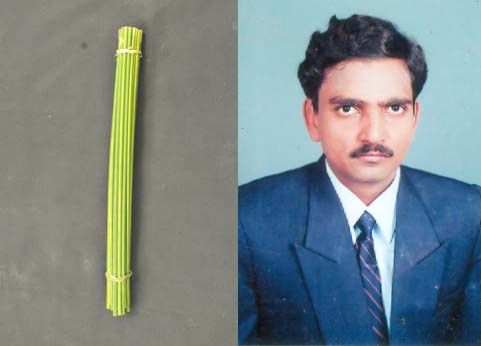

Considering the dangers of plastic waste, India in its effort to control pollution has implemented a nationwide ban on single-use plastic from today. Single-use plastics are essentially items made of plastic for single use. These items are mostly polythene bags, sachets, shampoo bottles, disposable glasses, etc., which are used and disposed of immediately after.
While all these objects made of plastic for single use, that will be banned from use may have been of great help for daily use, there are numerous eco-friendly alternatives.
One alternative is Andaman’s own gift to the world. Recently an eco-friendly reusable drinking straw has been invented by an eminent botanical scientist, Dr. Lal Ji Singh, Botanical Survey of India. Presently Dr. Lal Ji Singh is posted in Andaman.
About the Inventor:
Dr. Lal Ji Singh, M.Sc., M.Ed., D.Phil., NET, FLS (London), FBS, FAPT, FASA born in Ghazipur district of Uttar Pradesh and educated there at school level and went on to higher study at East of Oxford, University of Allahabad. After obtaining his M.Sc., M.Ed., D.Phil. degree he success in improvising a career as a botanist, teacher, Educationist and administrator eventually made him into one of the scientific men.
Dr. Singh joined Botanical Survey of India (BSI), an apex and premier taxonomic research organization of Government of India under the Ministry of Environment, Forest & Climate Change as a Scientist (Plant Taxonomist). He is serving in Andaman and Nicobar Islands since 2010. There he is a Joint Director and Head of the regional centre. Before joining BSI, he also served for Allahabad University and its various associate colleges.
He devoted his time to the exploration and collected plants and worked in revisionary, exploratory and conservation studies on flora of India especially of Andaman and Nicobar Islands, plant morphology, anatomy especially aerial Roots in dicots. He also designed the unique landscape of the Dhanikhari Experimental Garden cum Arboretum (DEGCA), BSI, ANRC for various conservatory sections especially herbal garden, navgrahvatika, aquatic plants, succulent plants, Orchidarium, Bambusetum, Palmatum, spices garden.
Several novelties & botanical curiosities have been discovered:described more than 15 taxa new to science, various new additions to Indian Flora, Occurrence of aerial roots in 13 dicotyledonous taxa, phloem wedges in roots of some Bignoniaceous Genera, vessels in some pteridophytes and vivipary in some non mangrove plants for the first time; an invention of eco-friendly reusable drinking Straw; made taxonomic revisions and molecular systematic studies on the taxa belonging to the families Cycadaceae, Loranthaceae, Musaceae, and Zingiberaceae; recorded phenology of 73 tree species of tropical zone of Andaman and Nicobar Islands for the first time; published over 118 research papers in leading national and international journals and authored book entitled “ New Vistas in Indian Flora” in 2 volumes; Member of various societies / committees; Co-ordinator of various research/training programme.Fellow of the Linnean Society of London (FLS), Indian Botanical Society (FBS), Association of Plant Taxonomy (FAPT), Andaman Science Association (FASA). Life member of Indian Botanical Society, International Society of Plant Morphologists, Palaeobotanical Society, Andaman Science Association and Plant Taxonomy; recipient of NET, award of honour by ASA (The Andaman Science Association), ASIAME (South Asia Thematic School), TOSI (The Orchid Society of India).
Keeping in view of socio-economy and in terms of ecological balance preventing environmental degradation, his more significant contribution is “An Invention of Reusable Eco-friendly and Biodegradable Drinking Straw”. It is an invention of economically important as well as ecologically significant resource which is unique about the invention is that it is aimed at reducing the use of plastic. It is made of an endemic bamboo species, Schizostachyumandamanicum
About Straw and its discovery from Islands:
The history of straw is a long and the idea of a straw was first invented exactly not known. The earliest drinking straw was found in a Sumerian tomb dated 3000 B.C. it is tube made from gold and precious blue stone lapis lazuli. In the 1800s the rye grass straw came into fashion because it was cheap and soft. The first known primitive natural straw made from the stem of grass strains with large hollow stems. The name straw comes from the fact they were literally made of straw.
The present invention is entirely different from other known natural drinking straws and is not known by any other inventorfrom any other bio geographical region of the world. It was made usable as an eco friendly drinking straw by the inventor after study of morpho- anatomical characters which has lead into the idea of utilizing its potential use as an eco- friendly natural drinking straw instead of modern synthetic drinking straw made from plastic and other synthetic fibers, and finding out a clear and simple manufacturing process to reform it in a usable.
Manufacturing process of this ecofriendly drinking straw is very simple and has demonstrated property of natural disinfectant and thus is reusable many times. This has been proved by demonstration, micro-morphological observation along with morpho- anatomical studies.
The commercialization of natural straw will add to the income to local people by growing this species on one hand and being biodegradable straw it can evade synthetic straw.
In future it will emerge as preferred choice not only in these Islands but also at global level because the afore said bamboo species can easily be cultivated to meet the requirement of global demand for ecofriendly natural products.
The present invention is markedly characterized by having well developed straw system i.e. exactly identical in morphology and function, aesthetically and sufficiently pleasing and appealing appearance, easy manufacturing, ecologically as well as economically significant, convenient to use and provides enjoyment Morpho-anatomical study led to the invention of multi time usable and eco friendly natural drinking straw which will be a substitute to synthetic hazardous straw- Dr. Singh said.
In future it will emerge as preferred choice not only in the Andaman and Nicobar Islands but also at global level because the afore said bamboo species can easily be cultivated to meet the requirement of global demand for eco friendly natural products.
The demonstration and Experimental observations of present invention were conducted at Dhanikhari Experimental Garden cum Arboretum (DEGCA), Botanical Survey of India, ANRC and people from different walks of life including eminent persons were involved. Most of them expressed their appreciation of the present invention. They showed their keen interest in the present invention of eco-friendly natural drinking straw and some eminent persons have opined that this should be patented. -Dr. Singh said.
The invention is timely campaign against plastic pollution. If the per capita consumption of plastic has to be brought down, it can be done by promoting natural product like bamboo and jute and other such inventions. Straw bamboo is found all over the islands and can be cultivated by farmers. After I registered the invention with the patent Office of Govt. of India, Its manufacturing, I took 5000 sample straws and distributed on occasion of Celebration of Environmental Day, 5 June, 2018 at India Gate, New Delhi in the gracious presence of honorable Minister and officials of Ministry of Environment, Forest & Climate change, Govt. of India -Dr. Singh said.


