Dr. Dinesh
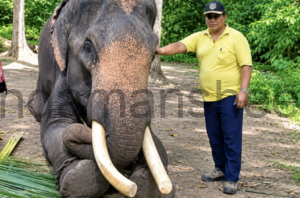
The story of Rajan, the celebrated swimming elephant of Havelock Island (Swaraj Dweep), remains one of the most fascinating and unusual chapters in the history of the Andaman and Nicobar Islands. His extraordinary association with the sea transformed him from a working elephant in the forests of Little Andaman into an internationally recognised tourist attraction, drawing visitors, photographers and filmmakers from across the world.
One person who played a significant role in Rajan’s life was Maung San Tun, a Mechanical Engineer and accomplished sportsperson. A champion weightlifter of Mangalore University and Osmania University, he also served as captain of the Inter-University team. He was the Andhra Pradesh State weightlifting champion and represented the state in arm wrestling as well. On a college day at Osmania college in 1986, he was presented with a memento by the then Indian cricket team player, Mohammad Azharuddin. Maung San Tun played an important role in training him at Hut Bay, Little Andaman, during some of the most memorable phases of the elephant’s life.
Rajan was brought to the Andaman Islands from Kerala in 1983. Initially, he understood only Malayalam but gradually became familiar with Hindi as well. Having been accustomed to eating coconut leaves and bananas in Kerala, he was initially unfamiliar with the natural vegetation of the Andaman forests. Over time, however, he adapted to the local jungle food.
Rajan was initially employed by the Forest Corporation in timber operations in Little Andaman, where elephants were used for hauling logs and other related work. However, following the Supreme Court restrictions that brought forest timber operations to a halt, Rajan gradually became idle around 2002. With his earlier work discontinued, his future in the islands became uncertain.
It was during this period that Rajan’s life took an unexpected turn. Three Japanese tourists, who had visited the islands after learning about the destination through Lonely Planet, became interested in making a documentary featuring him. During the filming, Rajan was encouraged to enter the sea and swim. What began as an unusual filming experience soon developed into an activity that he appeared to genuinely enjoy. His remarkable ability to swim in the open sea, against the backdrop of the turquoise waters of the Andaman Islands, attracted considerable attention.
In October 2004, a team approached local contacts for assistance in transporting Rajan from Hut Bay to Havelock for a photographic and filming assignment associated with the Hollywood film The Fall. A helicopter was chartered from Port Blair to Hut Bay to transport a filming crew of approximately seven members for the assignment.
Havelock was selected because of its exceptionally clear waters, which offered better underwater visibility than the relatively turbid waters around Hut Bay. Its beautiful beaches and transparent turquoise sea provided an ideal setting for filming Rajan swimming.
Transporting such a large animal across the sea was itself a challenging undertaking. A vessel, M.V. Badam, was chartered for the journey. At around 3 a.m., during high tide, Rajan boarded the vessel at Hut Bay, wading through the water to reach it. Accompanied by his mahout, Nasru Tigga, and Maung San Tun, he undertook an approximately 16-hour sea journey before reaching Havelock. It was an extraordinary maritime journey. The filming was subsequently conducted at Elephant Beach.
Rajan’s exceptional swimming ability eventually attracted the attention of Indian filmmaker Tarsem Singh, who featured him in the 2006 Hollywood film The Fall. The film included spectacular sequences of elephants swimming in the open sea, bringing international attention to Rajan and his unusual association with the Andaman Islands. The underwater sequence of an elephant swimming gracefully became one of the film’s memorable visual elements.
Ironically, the filming assignment that brought Rajan to Havelock marked the beginning of an entirely new chapter in his life. What was initially intended as a temporary visit would eventually turn into a permanent home.
One of the most glamorous episodes in Rajan’s association with Havelock was his connection with the Kingfisher Swimsuit Calendar. During the final phase of the 2008 Kingfisher Swimsuit Calendar shoot, held in late 2007, industrialist Vijay Mallya personally accompanied the crew and models to Havelock Island. The photographic assignment was led by renowned fashion photographer Atul Kasbekar, and Rajan became part of this memorable event. Mallya arrived aboard his vintage luxury yacht, Kalizma, which had been brought to the Andaman Islands for the occasion. The yacht served not only as an impressive backdrop for the photographs but also as a venue where he hosted members of the crew and guests. The shoot covered picturesque locations such as Radhanagar Beach and Elephant Beach. Mallya was also seen enjoying the surf alongside the crew. Several prominent models featured in the 2008 edition, while industrialist Gautam Singhania also joined Mallya during the Havelock leg of the assignment.
Interestingly, the 2008 edition was the first Kingfisher Calendar to be shot entirely in India, covering diverse destinations such as Goa, Ladakh, Udaipur and the Andaman Islands. Rajan’s presence added a distinctive local attraction to this prestigious photographic assignment, bringing together the glamour of fashion photography and the extraordinary natural beauty of Havelock.
The renowned UK-based wildlife photographer and author Steve Bloom also photographed Rajan at the famous Radhanagar Beach, approximately five years after the tsunami. His photographs further helped bring international attention to this extraordinary elephant.
The devastating tsunami of 26th December 2004 changed the course of Rajan’s life. The disaster disrupted the arrangements for his return to Little Andaman, and the vessel that had transported him was no longer available.
Consequently, Rajan remained at private hotel premises in Havelock, where arrangements were made for his continued upkeep. His mahout was Nasru Tigga, while Masan was associated with his ownership. What had initially been planned as a temporary stay eventually became a significant chapter of his life. Havelock became his home, and the sea became his playground.
Over the following years, Rajan’s popularity spread far beyond the islands. Tourists from different countries travelled to Havelock hoping to witness the unusual sight of an elephant swimming in the ocean.
Among his distinguished visitors was Sheikh Hamdan bin Mohammed bin Rashid Al Maktoum, the Crown Prince of Dubai. In March 2014, the royal visitor reportedly travelled to Havelock Island to swim and dive with Rajan, the famous ocean-swimming elephant. His visit further brought international attention to Rajan and enhanced the island’s reputation as the home of this extraordinary attraction.
Although elephants are naturally capable swimmers, Rajan appeared to have a special affection for the sea. He seemed genuinely delighted to enter the water and was reportedly willing to swim whenever tourists arrived. His cheerful disposition and enthusiasm made the experience memorable for visitors. For many, swimming alongside Rajan in the clear waters of Havelock was an experience unlike anything they had encountered elsewhere.
A donation box was kept near the hotel reception, accompanied by a banner carrying an emotional appeal. It stated that if Rajan were sent back to Kerala, he might end up chained and confined in a temple. This message reportedly touched the hearts of many visitors, who contributed generously towards his upkeep. Tourists donated not only Indian rupees but also foreign currencies. The sight of visitors from different countries contributing out of sympathy reflected the special affection Rajan had inspired among people who came to know his extraordinary story. However, whether these contributions were entirely utilised for his upkeep cannot be independently confirmed.
Rajan died in 2016, reportedly following a snake bite while in the jungle. His death marked the end of an extraordinary chapter in the tourism history of Havelock Island. With his passing, the islands lost one of their most unusual and memorable attractions.
Rajan was much more than a tourist attraction. He represented a rare and unforgettable connection between wildlife, tourism and the ocean. The sight of a giant elephant swimming gracefully through the crystal-clear waters of Havelock was an experience that few other destinations in the world could offer.
His life brought together people from different countries, filmmakers, photographers, celebrities and ordinary tourists, all united by their fascination for an elephant who seemed to have an extraordinary love for the sea.
Today, as Havelock continues to attract tourists from across the globe, Rajan remains part of its distinctive identity. His story is a reminder that sometimes an animal can become much more than an attraction; it can become an enduring symbol of a destination.
Rajan may have disappeared from the shores of Havelock, but the memories of the gentle giant who swam into our hearts and made the ocean his playground will forever remain part of the island’s story.
(The author is a Dental Surgeon and freelance journalist. E-mail: dineshdentalclinic@gmail.com)