
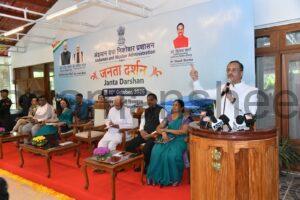
Sri Vijaya Puram, Oct 30: Lieutenant Governor of Andaman and Nicobar Islands, Dr. Dinesh Sharma, on Friday outlined several important initiatives and proposed measures to address public grievances relating to drinking water, healthcare facilities, road infrastructure and women’s safety during the Janata Darbar held at Lok Niwas. Interacting with representatives of various political parties, Panchayati Raj institutions, municipal bodies and members of the public, he said that the Administration was committed not merely to receiving complaints but to ensuring practical and time-bound solutions to issues affecting islanders.
The Lt Governor stated that this was his first Janata Darbar in Sri Vijaya Puram. Earlier, he had interacted with residents and heard their grievances during similar programmes at Swaraj Dweep and Shaheed Dweep. Clarifying the purpose of the initiative, he said that submission of an application during the Janata Darbar did not necessarily mean that every issue could be resolved immediately, as several matters required departmental procedures, technical clearances and financial approvals. However, he assured the public that all applications received would be examined and the concerned departments would be held responsible for taking appropriate action.
Highlighting the persistent drinking water shortage in several areas, Dr. Sharma informed that significant steps had been initiated towards constructing check dams at Bada Nallah and Burma Nallah to improve water availability in surrounding areas. He said that permission had been granted by the Administration to prepare the necessary reports for the proposed projects, while the process involving the Central Water Commission was also being taken forward.
The proposed projects are expected to strengthen water storage facilities in Bambooflat and Stewart Gunj. According to the Lieutenant Governor, the plan envisages developing a water storage capacity of approximately 1.8 crore litres through these reservoirs, which would help increase the availability of drinking water on a daily basis.
He further informed that approval had also been accorded to a proposal for developing additional water storage capacity in the Sippighat area. Dr. Sharma expressed confidence that the completion of these projects would significantly improve drinking water availability in the concerned areas and provide relief to residents who have been facing difficulties due to inadequate water supply. He, however, clarified that the projects would require time for completion, but the necessary administrative process had already been initiated.
Making an important announcement regarding healthcare infrastructure, the Lieutenant Governor stated that the proposal for constructing a modern 500-bed hospital in the islands had received administrative approval.
He said that the proposed hospital would substantially reduce the dependence of island residents on major hospitals in mainland cities for treatment of serious illnesses. At present, several patients are compelled to travel to Chennai and other cities to access advanced medical facilities and specialised treatment.
The establishment of the proposed modern hospital would help bring advanced healthcare facilities and specialist medical services closer to the people of the islands. He acknowledged that construction of such a major healthcare facility would take time, as detailed planning and construction procedures would have to be completed. Nevertheless, he assured that strengthening healthcare infrastructure remained one of the Administration’s major priorities.
Addressing concerns over delays in the construction of the National Highway 4, Dr. Sharma said that he was aware of the difficulties being faced by residents due to the prolonged delay in the project. He observed that the repeated withdrawal of the contractor from the construction site had caused considerable inconvenience to the public.
The Lieutenant Governor informed that he had personally spoken to the concerned department to understand the reasons behind the delay. During the discussion, the contractor had cited difficulties in the availability of essential construction materials as one of the major reasons affecting the progress of work.
Dr. Sharma said that he had issued clear directions to the concerned officials and executing agency to ensure the availability of necessary materials so that construction could proceed without further interruptions. He informed that a target had been set to make at least one stretch of the road motorable, with vehicles able to travel at the prescribed speed per kilometre, by January or the first week of February.
He also stated that the Chief Engineer had been directed to continuously monitor the progress of the project and immediately bring any obstacles to the notice of the Administration so that timely intervention could be ensured.
Responding to the demand for safe accommodation facilities for working women, the Lieutenant Governor informed that steps had been initiated to provide 84 beds in a newly constructed residential complex at Rangat.
The proposed facility will include rooms with double-bed arrangements, four-bed accommodation units, separate rooms for women who may fall ill, a kitchen, dining hall and library. He said that the initiative would provide a safe and comfortable residential facility for women who have to stay away from their families in connection with their employment.
The facility is expected to address an important requirement of working women in the Middle Andaman region by providing them with secure accommodation and essential residential amenities.
Concluding his interaction, Dr. Sharma said that every application received during the Janata Darbar had been registered and arrangements had been made to provide responses to the applicants. He further announced that an online application portal would be opened approximately 10 days before the next Janata Darbar, with priority being given to the first 100 applicants.
He urged residents to clearly mention one or two major grievances in their applications so that the concerned departments could examine the matters and initiate appropriate action without unnecessary delay. He reiterated that the objective of the Janata Darbar was to establish direct communication with the public and ensure effective redressal of their grievances.


