
Sheekha Bureau
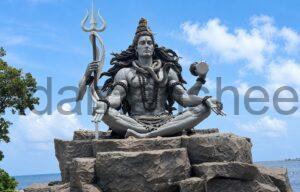
Sri Vijaya Puram, Sept 04: A majestic Lord Shiva sculpture unveiled near the Hornbill Nest has quickly emerged as a striking new attraction in the city, drawing hundreds of people who have been stopping to catch a glimpse of the grand statue. The imposing installation, towering against the backdrop of the sea, has left visitors awestruck with its scale, distinctive appearance and spiritual presence.
Talking to Andaman Sheekha, sculptor Mr. Raghesh Sasi said the idea behind the sculpture evolved considerably during the course of its creation. The work began in April 2025 after he was approached for the project and was completed over approximately 17 to 18 months. He initially prepared two drawings of Lord Shiva in different postures, following which the present design was selected.
Mr. Raghesh said the surrounding environment played an important role in shaping the final appearance of the statue. Since the sculpture stands close to the sea, he wanted to introduce a sense of movement rather than portraying Lord Shiva as completely still. “The sea is in front, so there will be wind. I thought there should be some movement in the statue,” he explained.
This creative thought led to the addition of a flowing cloth attached to the trident, along with carefully balanced elements around the figure. According to him, the intention was to create symmetry while giving the impression that the divine form was gently responding to the natural surroundings.
The colour scheme was also inspired by the location. Rather than using a conventional bright or stark appearance, Mr. Raghesh chose different shades of grey and darker tones that would blend naturally with the sea, rocks and surrounding landscape. He said the colour of the sea and the local stone influenced his decision, helping the sculpture appear as though it belongs naturally to the setting.
The Lord Shiva statue itself stands 20 feet high, while the overall structure, including its base, reaches approximately 32 feet. The sculpture has been made using cement and sand, with reinforcement inside, while the main structure remains hollow. Mr. Raghesh said the material was selected after considering strength and durability, particularly in the island environment.
The creation of the massive sculpture was not a solo effort. Raghesh was joined in the demanding sculpting journey by Prajeesh PP, Nidhin E, Nidhish Gopinath, Nandakumar, Aneesh Kunjumon, Srirag and Dibin. Working together, the team spent months transforming the original artistic concept into a large-scale structure, carefully developing its form, proportions and finer details while dealing with the practical challenges involved in constructing a sculpture of such magnitude.
The sculptor, who hails from Kasaragod, Kerala, holds a BFA in Fine Arts from Raja Ravi Varma College of Fine Arts at Mavelikkara. He has worked on sculptures at several locations across India, including a war memorial at an Army camp in Jabalpur, besides projects in Nagpur, Chandrapur and Punjab.
His experience also extends beyond India. Mr. Raghesh said he worked for around eight years in Dubai, including projects associated with the Dubai Shopping Festival and Global Village, where he worked on large-scale sculptures and installations.
For him, however, the Lord Shiva sculpture at Hornbill Nest represents more than merely another large artwork. The carefully conceived posture, flowing elements and colours inspired by the sea give the divine figure a distinctive character, while its imposing presence has already begun attracting people from different parts of the city.
As devotees and visitors pause before the towering form of Mahadev, the sculpture is fast becoming a place where art, nature and faith come together—offering the city not merely a monumental structure, but a powerful visual reminder of Lord Shiva’s timeless spiritual presence.


