N. Francis Xavier
Part VII, (Continued from last week)
Hemraj lowered the rifle, not believing his own eyes at the sudden change in the pursuit.
“Down, everybody”, SheoBux Mina, the convict from the Princely state of Tonk, who held the tiller shouted.
Before they could duck a shower of arrows flew over their heads.
They landed on the Great Andamanese canoes. The shouts of pain indicated that at least some of them found their mark.
Hemraj realized that the forest on the other side of the creek was teeming with the Jarawa, the arch enemy of the Andamanese.
They must have watched the boats and understood that the Andamanese were pursuing runaways. They waited till the canoes came within range and discharged the arrows with deadly accuracy.
Maia Biala was a marked man for the Jarawas. He was the one who lead the outsiders to raid their villages on the so called “punitive expeditions”.
The Jarawas resented outsiders entering their territories. They hated the Andamanese for selling out to the strangers who came from across the seas and settled on the eastern shore.
By surrendering to the outsiders the Andamanese have brought death upon themselves. The Jarawas observed how strange diseases quickly decimated the Andamanese.
“Where would the next volley of arrows land?”Hemraj wondered. They crouched on the bottom boards of the whaler, frozen with fear. The boat started drifting towards the shore, with no one to hold the tiller.
Suddenly someone called Hemraj by his name. Hemraj was startled. Who would know him in this wilderness, that too in the Jarawa territory?
“Hemraj, it’s UngadeAmey, he’s waving to us to come ashore”, whispered Debideen who peered over the gunwales to see who it was.
Hemraj remembered Ungade Amey. He was captured some years ago by the convicts working near Dhani Khari and kept on Viper by Mr Homfray.
Maj. Gen. D.M. Stewart, the then Chief Commissioner wanted to use Ungade as a means of establishing friendly relations with the hostile Jarawas.
MrJ.N. Homfray, Officer in charge of the Andamanese Homes and Convict Goodur were asked by Gen. Stewart to treat Ungade with kindness and learn their language. Hemraj, being the boatman became a good friend of Ungade.
Hemraj remembered Ungade’s reaction when he saw a match being struck for the first time. The tribe did not know how to make fire. They preserved the fire in resin torch, handed down generations ago, and carried it wherever they went. Hemraj learnt bits of their language. When Ungade was to be dropped back it was he who took him in the boat, with lots of gifts, and boxes of Lucifer matches. It was an emotional parting at Constance Bay where they left him.
Hemraj got up and saw Ungade on the shore. He looked like a chief, much bigger and taller than when he saw him last. He wore a necklace of shells around him neck, and a magnificent chest guard made of tree bark. Pieces of red cloth were tied round his head and forearms. In his hands he held a taut bow and a few arrows. But there was no hostility on his face.It broke into a big smile. With outspread arms Ungade Amey gestured to Hemraj to come ashore.
Around Ungade there were about a hundred Jarawa warriors, all armed with bows and arrows, tipped with pieces of iron sharpened to a point. Their ebony black bodies glistened in the light.
Ungade saw the hesitation in the eyes of Hemraj and issued an order. Next moment the Jarawas lowered their bows and moved backwards. It was clear that Ungade was a chief.
Hemraj could see some women and children also in the background. One woman stepped forward. She too had a smile on her face. Hemrajswa that it was Natanata Waye, who was captured by Goodur during a raid. She was pregnant at that time and could not runaway like the others. She too was treated very kindly by Homfray and returned to the forest with lots of gifts.
Natanata pointed to a little girl by her side. Hemraj understood that she was trying to tell him it was she who was in her womb at the time of her capture.
Mina, who took the tiller by then, guided the boat to the shore. As soon as the bows touched the sand bank Hemraj jumped on shore. Ungade rushed and embraced him a bear hug. They slapped each other on the back for some time, as they searched for words of greeting.
One by one all the men waded ashore. They made friendly gestures to the Jarawas and explained through sign language how they had escaped from the prison.
Ungade, who, by that time recollected some words of Hindustani asked Hemraj about Goodur and MyoJolah. Hemraj explained how Goodur got an absolute pardon for his work among the Andamanese and Jarawas and went back to his native place in India. MyoJolah was also well, and in Port Blair. But, right now he too must be searching for them, Hemraj explained. MyoJolah was the Andamanese name for J.N Homfray. It meant “Master of Masters”.
After securing the boat the men followed their Jarawa hosts to their large communal hut deep in the forest. There, each by their own hearth, lived the Jarawas, under one roof, sharing all that they could hunt or gather from the forest. Skulls of wild pig, tied with cane hung from the roof of the hut like festoons. Bows and arrows, baskets, nets and other implements were neatly stowed in their places.
Ungade took Hemraj to a corner of the hut. From a packet, wrapped in several layers of bark he took out a bundle. Hemraj saw a few matchboxes. They were the same Lucifer matches given to Ungade when he was returned to the forest years ago.
Hemraj understood that it must have been the power to make fire which led to Ungade becoming the Chief. He owed it to Goodur and Homfray. There was gratitude in his eyes when he spoke about them.
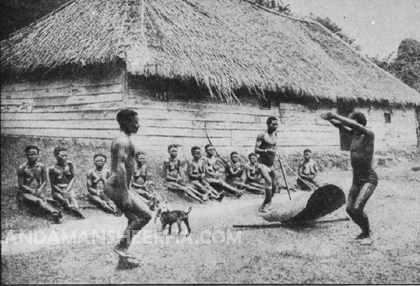
Soon the fires were lit and a dance started in honour of the guests.
“Oley oleyoleyley…Leloleloleyoley…” sang the Jarawas as they swayed and stamped their feet around the fire. Hemraj and friends also joined the celebration. to be continued )

