Sheekha Bureau
Port Blair, March 15:A delegation of media representatives from the Andaman and Nicobar Islands has returned to Port Blair after completing a rare and highly enriching educational media tour across several important government institutions and research establishments in mainland India. The tour, which followed the route Chennai – Mahabalipuram – Sriharikota – Coimbatore – Nilgiris – Chennai, is believed to be the first of its kind in which journalists from the islands were given access to some of the country’s most prestigious and otherwise inaccessible establishments.
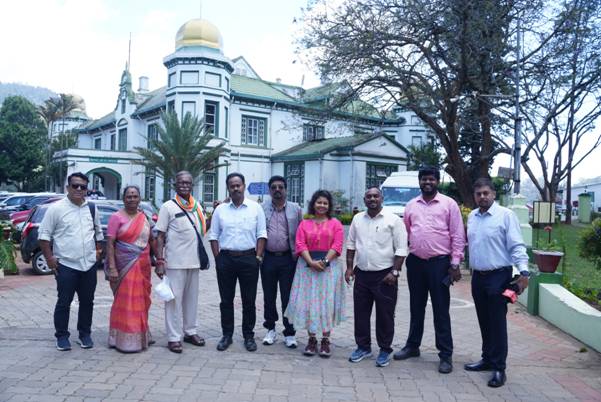
The media delegation comprised Mr. K. Ganeshan, Chief Editor of Andaman Express; Mrs. Lakshmi Ganeshan, Editor of Andaman Kural; Mr. Viju Nair, Chief Editor of The Daily Telegrams; Mr. Vijay Roy, Chief Editor of The Echo of India; Mr. Tarun Kartick, Editor of Nicobar Times; Mr. John Wilbert, Editor of News Aaptak; Ms. Rashmi Rao, Editor of Wave Andaman; and Mr. Sanjib Kumar Roy, Editor of Andaman Sheekha. The press tour was conducted under the supervision of Mr. T. Vijay, Director, Press Information Bureau (PIB), Andaman and Nicobar Islands, who led the delegation throughout the study visit.
The week-long programme provided the delegation with an opportunity to observe first-hand the functioning of key national institutions involved in space research, communication infrastructure, shipping, scientific research, tribal welfare and renewable energy. Despite a hectic schedule, the visit proved to be an inspiring and educational experience for the participating journalists, many of whom have already published several reports based on their observations during the tour.
The delegation began its journey on March 9, 2026, travelling from Port Blair to Chennai. In Chennai, the team visited All India Radio (AIR) Chennai and Doordarshan Chennai, where officials briefed them on broadcasting operations, newsroom management, programme production and the evolving role of public service media in the digital age.
The delegation also visited the Chennai Port, where they observed cargo-handling operations related to mainland–island shipping services. Officials explained the functioning of dedicated berths used by vessels operating between Chennai and Port Blair and discussed the logistics involved in maintaining regular shipping connectivity.
Another significant visit was made to the CANI Submarine Cable Landing Station at Santhome Beach, which serves as the starting point of the 2,313-kilometre undersea cable network that connects Port Blair and several other islands with high-speed internet. Officials from BSNL explained how digital data travels from the landing station through the submarine cable system to the islands, dramatically improving internet connectivity in the region.
On March 10, the delegation travelled to Mahabalipuram, where they explored the region’s tourism potential and visited coastal preservation sites managed by the Archaeological Survey of India.
The team also visited the Madras Crocodile Bank, where conservationists explained about scientific research related to reptile conservation. The journalists were also introduced to snake venom extraction techniques used for producing life-saving anti-venom, a topic particularly relevant for the Andaman region where snakebites are a public health concern.
A highlight of the tour came on March 11, when the delegation visited the Satish Dhawan Space Centre (SDSC), Sriharikota, the primary rocket launching facility of the Indian Space Research Organisation (ISRO). The journalists were given a rare opportunity to visit the rocket launch control centre, typically seen only during televised launch events, and were also taken to Launch Pad–1 and Launch Pad–2.
On March 12, the delegation travelled to Coimbatore and later to Coonoor, where they visited the historic Pasteur Institute of India. Scientists briefed the team on vaccine research, disease prevention and the institute’s role in vaccine production in India. The delegation interacted with the institute’s Director, Dr. S. Sivakumar, and other scientists who explained both historical and modern vaccine manufacturing processes.
The tour continued through the Nilgiris region, where the delegation visited the Central Soil and Water Conservation Research Institute, a Toda tribal hamlet, the Tribal Research Centre, and the Pykara hydroelectric and solar energy projects, Ooty, gaining insights into environmental conservation, tribal welfare and renewable energy initiatives.
On March 14, the delegation visited the Integral Coach Factory (ICF) in Chennai, one of India’s premier railway manufacturing units where modern Vande Bharat trains are produced. Established in 1955, the factory has manufactured tens of thousands of railway coaches and today produces nearly 4,000 coaches annually, playing a key role in India’s railway modernisation programme.
The delegation finally returned safely to Port Blair on March 15, concluding what participants described as an inspiring journey that deepened their understanding of several national institutions and development initiatives with direct relevance to the Andaman and Nicobar Islands.


