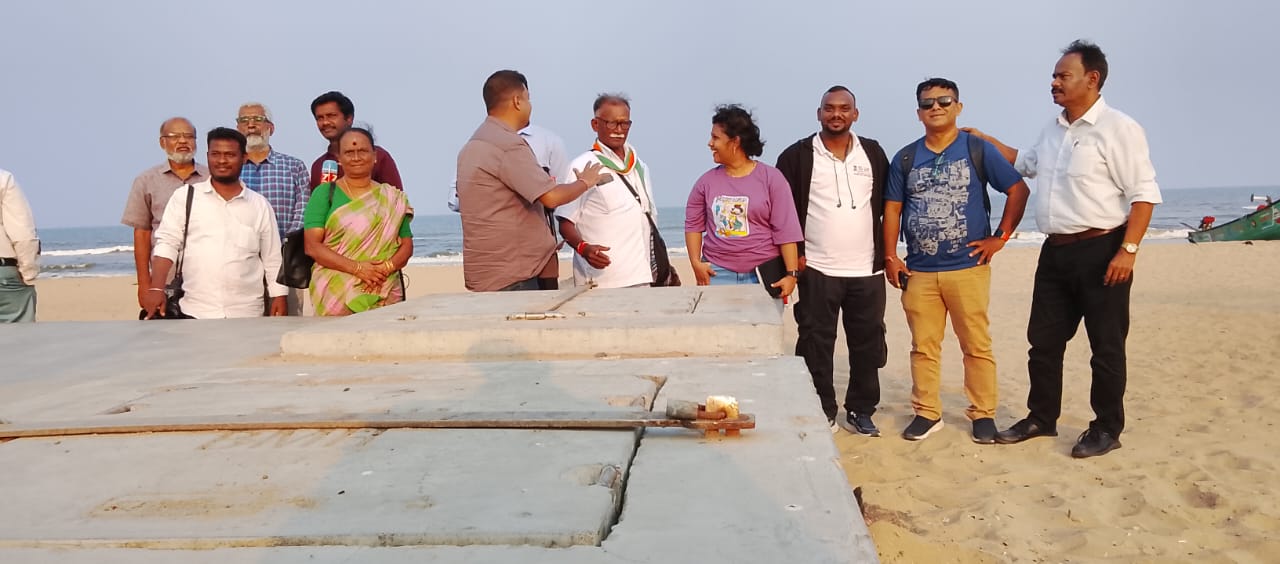

Sri Vijaya Puram, Feb. 27:The submarine optical fibre cable project connecting the Andaman and Nicobar Islands with mainland India has significantly strengthened digital connectivity across the archipelago and is playing a vital role in the region’s development. This was stated by Dr. S. Murty, Principal General Manager, BSNL, Chennai, while explaining the importance and functioning of the Chennai–Andaman and Nicobar Islands (CANI) submarine optical fibre cable project.
Talking to a media delegation, led by PIB, Port Blair, Andaman and Nicobar Islands, Dr. Murty said the project was funded by the Government of India through the Department of Telecommunications under the Universal Service Obligation Fund (USOF), which is now known as the Digital Bharat Nidhi (DBN). The total capital cost of the project was about ₹980 crore, and Bharat Sanchar Nigam Limited (BSNL) was entrusted with the responsibility of implementing and maintaining the project.
He informed that the submarine cable project was commissioned in July 2020 and has been functioning successfully for nearly five and a half years. According to him, the system has been running smoothly with only one major fault reported so far near Car Nicobar during September–October 2025. The fault was restored within one month through coordinated efforts, which he described as a significant achievement since submarine cable repairs normally take between three and six months.
Dr. Murty explained that the project involved laying about 1,500 kilometres of submarine optical fibre cable under the sea from Chennai to Sri Vijaya Puram (Port Blair). From Sri Vijaya Puram, the network has been extended to several other islands through additional cable links, ensuring high-speed connectivity across the region.
A total of eight cable landing stations have been established under the project. Each cable coming from the sea terminates at a Beach Manhole (BMH) before being connected to the cable landing station through land-based optical fibre. To ensure reliability, the land cables have been laid through two separate routes—Path A and Path B—so that communication services remain uninterrupted even if one line is damaged.
From Sri Vijaya Puram, three northern islands—Long Island, Swaraj Dweep (Havelock) and Rangat—have been connected through the network. On the southern side, connectivity has been extended to Hut Bay in Little Andaman, Car Nicobar, Kamorta and Campbell Bay in Great Nicobar. These connections have enabled the islands to receive high-speed bandwidth that supports modern communication and digital services.
Dr. Murty said that optical fibre technology offers extremely high data capacity. At present, the CANI project provides a bandwidth capacity of around 400 gigabits per second. However, he explained that the fibre itself has virtually unlimited capacity and that the bandwidth can be increased further simply by upgrading the terminal equipment at both ends without replacing the existing cable.
Under the project, four optical fibre pairs have been laid. Two fibres are used for the main and standby communication links, one fibre has been allocated for defence communication purposes, while the fourth fibre has been kept as a spare to ensure redundancy and reliability.
He further said that in case the submarine cable is damaged, communication services in the islands would temporarily shift to satellite bandwidth, which was the earlier mode of connectivity before the submarine cable project was implemented. However, satellite bandwidth is limited compared to optical fibre connectivity, and internet speeds would be significantly reduced during such situations.
Dr. Murty also mentioned that the Government of India is considering plans for additional submarine cable connectivity to the islands from another route to strengthen redundancy and expand connectivity to more remote islands. However, he clarified that the final decision and detailed plans would be announced by the Department of Telecommunications.
Highlighting the importance of the project, he said the submarine optical fibre cable has transformed digital infrastructure in the Andaman and Nicobar Islands by providing reliable high-speed internet connectivity for residents, government services, tourism, education and defence operations. He added that continuous monitoring and maintenance systems have been put in place to ensure uninterrupted services and safeguard the cable infrastructure.